Showing posts with label clean energy. Show all posts

Friday, January 18, 2013

Gas From Coal - KBR Edition

 Left: KBR TRIG gasifier schematic. Right: TRIG gasifier demo unit, Wilsonville, AL. Source: http://www.kbr.com


A recent post was about a patent issued to Bechtel for refueling natural gas combined cycle power plants with syngas derived from coal, and how it may be caught between market forces and a regulatory environment that could limit, if not preclude, its commercialization. This time, we’ll look at an invention from another international engineering, procurement, and construction company that pertains to syngas production.

KBR


KBR  (NYSE:KBR), headquartered in Houston, TX, employs about 27,000 people worldwide in its various activities. The company, in addition to being a major defense contractor, is a major player in the energy, hydrocarbon, minerals, civil infrastructure, power and industrial markets. Started in 1901, the company claims milestones such as constructing the world’s first catalytic cracking facility in 1942 and creating a new ammonia process for fertilizer production in the 1960s, which had direct implications for improved global food and crop yields.

KBR’s intellectual property portfolio includes 170 issued US patents and applications (assigned to Kellogg Brown & Root). One of its more recent patents is US 7,955,403, issued under USPTO’s Green Technology Pilot Program.  The '403 patent is the subject of today's post.

The Invention


The ‘403 patent, ‘Systems and methods for producing substitute natural gas’, was invented by Siva Ariyapadi and Philip Shires and issued on June 7, 2011. The application was filed in May 2009, and assuming a 2–3 year lead time for R&D of the invention prior to filing, the genesis of this invention was probably in the 2005–2006 time frame - about the time that Bechtel was probably researching its refueling patent. See the Bechtel post for additional information on the natural gas market production and prices around that time and in the years since.

The inventors developed improvements to KBR’s synthetic natural gas system to provide coal gasification of low grade coal in a manner that reduces auxiliary power and process water requirements. Ariypadi and Shires teach that

[c]lean coal technology using gasification is a promising alternative to meet the global energy demand. Most existing coal gasification processes perform best on high rank (bituminous) coals and petroleum refinery waste products but are inefficient, less reliable and expensive to operate when processing low grade coal. These low grade coal reserves including low rank and high ash coal remain underutilized as energy sources despite being available in abundance. Coal gasification coupled with methanation and carbon dioxide management offers an environmentally sound energy source. Synthetic or substitute natural gas (“SNG”) can provide a reliable supply of fuel. SNG, with the right equipment, can be produced proximate to a coal source. SNG can be transported from a production location into an already existing natural gas pipeline infrastructure, which makes the production of SNG economical in areas where it would otherwise be too expensive to mine and transport low grade coal. Alternatively, in developing countries, the production and supply of clean efficient SNG to densely populated cities instead of the transport and use of low grade coal as an energy source in a multitude of inefficient and polluting facilities within the cities provides the means to effectively mitigate pollutants and carbon capture.

Their claim 1 states:

A method for producing synthetic natural gas, comprising:

gasifying a carbonaceous feedstock within a gasifier to provide a raw syngas;
cooling the raw syngas to provide a cooled raw syngas;
processing the cooled raw syngas within a purification system to provide treated syngas, wherein the purification system comprises a flash gas separator in fluid communication with the gasifier and a saturator;
converting the treated syngas to synthetic natural gas to provide steam, a methanation condensate, and a synthetic natural gas;
and introducing the methanation condensate to the flash gas separator.

The Technology and Its Use


The improvements memorialized in the ‘403 patent are a component of KBR’s TRIG™(Transport Integrated Gasification) technology which allows the gasification of inexpensive, low grade feedstock such as lignite, sub-bituminous, and high ash coal. KBR and Southern Company successfully demonstrated the system at USDOE’s Power Systems Development Facility in Wilsonville, Alabama. The companies are commercially deploying the TRIG system around the world. Major projects include two in China that will provide a retrofit to an integrated gasification combined cycle plant and a coal to chemicals facility, and an IGCC unit being installed for Mississippi Power in Kemper County, MS.

This technology, by allowing the efficient use of lower quality coal resources in a manner that reduces process energy requirements and water use, is an excellent example of truly clean technology.

Other examples may be found in other articles here on The Inkling, and in Way Better Patents’ USPTO Green Tech Pilot Program Discovery and Analysis Report.


Wednesday, November 7, 2012

A Piece of the Clean Domestic Energy Puzzle


Way Better Patents patentECO clean tech ecosystem focuses on inventors, innovations, invention, and patents in clean technology. Major inventive domains consist of seven patentECO Indexes:

Agriculture
Air
Energy
Extraction & Harvesting
Industry
Transportation
Water

Curiously, the USPTO’s Green Tech Pilot Program has issued very few patents in the Extraction and Harvesting Index. One of these is US 8,162,049 issued in April 2012 to Peter E. Rose (Salt Lake City, UT) and assigned to the University of Utah Research Foundation. Mr. Rose’s invention, “Injection-backflow technique for measuring fracture surface area adjacent to a wellbore,” provides techniques for using tracer materials as a measurement tool to provide data for an underground reservoir fluid flow model. The model calculates fracture surface area resulting from hydraulic fracturing and geothermal formation stimulation. Increased surface area of fractures correlates with increased energy extraction rates.

The invention is summarized in Claim 1:

A method, comprising:
measuring an initial temperature profile along the length of a wellbore;
  
injecting a tracer composition into the wellbore at an initial concentration, wherein the tracer composition includes a first thermally reactive tracer and a second thermally reactive tracer, wherein the second thermally reactive tracer is less thermally reactive than the first thermally reactive tracer;
 
allowing the tracer composition to diffuse within a subterranean reservoir for a time;
measuring a second tracer concentration of the second thermally reactive tracer and a first tracer concentration of the first thermally reactive tracer as a function of time; 
and

calculating a reservoir fracture surface area using the second tracer concentration and the first tracer concentration and thermal decay information of the first thermally reactive tracer and the second thermally reactive tracer.

Claims 4 through 6 provide the types of tracers to be used; these include:


  • deuterated water, alkali metals, alkaline-earth metals, halides, and combinations thereof
  • 2,6-naphthalene disulfonate
  • esters, amines, aryl halides, rhodamine WT, eosin Y, dyes, halogenated fluoresceins, and combinations thereof.


Finally, the subterranean reservoir to which this measurement technique may be applied includes a geothermal reservoir, gas reservoir, oil reservoir, or combination thereof. In other words, the method can be applied to the hydraulic fracturing (aka fracing or fracking) method used in shale gas fields such as the Marcellus and Utica shales.

Mr. Rose’s Figure 1 shows a general engineered geothermal system (EGS 100) including a single injection well 110 and two production wells 120A and 120B. A fluid can be injected into the injection well where the fluid travels through fractures 130 in the adjacent formations outward towards the production wells. In the case of heat recovery, the fluid is heated via natural underground thermal sources 140. The production wells are located such that the heated fluid can be recovered and directed to a suitable heat transfer mechanism for producing power or the like, e.g. steam turbines 150. As the inventor points out, the same hydraulic stimulation method can increase production of any well-based production of energy and/or materials (e.g. natural gas, oil, and the like).

Inventor Rose is one of the innovators whom we can thank for helping to unlock US underground energy sources, provide more efficient means for extracting those resources, and reducing the price of energy for all of us.

A footnote: claim 15 states that “the reservoir fluid flow model is run in a numerical simulation program.” Although the USPTO did not provide a software-related cross reference classification for this claim it refers specifically to software. There has been a steady drumbeat by many bloggers and commentators that software should not be patented. Software, however, is intellectual property, and deserves protection via patents, as do the myriad of other types of inventions found in the patentsphere.


Thursday, October 4, 2012

Extra Energy for Wind Turbines


A large proportion of the inventions approved by USPTO’s Green Technology Pilot Program are directed toward wind turbines. All aspects of wind energy have been patented under the program – towers, turbines, nacelles, blades, generators, control systems, even construction techniques. Wind turbines convert the kinetic energy of wind to rotational motion of the blades (or rotor), thence to electrical energy via the coupling of the rotor to a generator housed in the turbine nacelle.  In operating wind turbines for generating electricity it is sometimes necessary to reduce the power output of the turbines in a wind farm.  Conditions requiring reduced turbine power output might include maintenance periods, low or high wind conditions outside the operating envelope of the turbine, or periods when electricity generated by the wind turbine is not needed. Reduced wind turbine output (or “wind turbine curtailment” in the technical parlance) means that the aerodynamic energy present in wind is not captured, and from a clean tech standpoint, is wasted.


The New


Figure from US 7,750,490
Method and system for extracting inertial energy from a wind turbine”, US 7,750,490, was issued to Hartmut Scholte-Wassink (Lage, Germany) on July 6, 2010. The patent was assigned to the General Electric Company. GE has been a very significant participant in the Green Tech Program receiving more patents than any other assignee. The patent provides two sets of claims: claims 1–8 are systems claims, and claims 9–15 are methods claims. Claim 9, the independent method claim states:
"A method for operating a wind turbine during curtailment of the wind turbine, the wind turbine comprising a generator and a rotor having at least one rotor blade, the wind turbine also comprising a drive train that includes at least one shaft coupled to the rotor and configured to drive the generator, said method comprising:
operatively coupling a control system to the wind turbine, the control system configured to adjust wind turbine operation to facilitate increasing a speed of rotation of the rotor during curtailment of the wind turbine;
and, operatively coupling an extraction device to the generator, the extraction device configured to extract inertial energy stored in the drive train upon release of the curtailment."
The extraction device in this invention constitutes a frequency converter (shown as 44 in the patent’s Figure 2) that is used to extract the potential energy stored in the increased shaft rotation speed described in claim 9 and other claims.

The Old

Figure from US 452,546 - May 1891

The earliest wind turbine patent related to the ‘490 patent, via the same original classification, was not issued by the Green Tech Pilot Program. It preceded the start of the Program by more than 118 years. J.M. Mitchell of Lawrenceville, GA was awarded patent US 452,546 in May 1891 for a “Wind apparatus for generating electricity and charging secondary batteries.” Mitchell explains:
"My invention relates to that class or type of mechanism whereby the natural powers or forces are sought to be utilized for the generation of one or more electric currents, the object being to supply electric currents having suitable energy for the operation of electric-arc lamps or other devices, or, on the other hand, for incandescent lamps, or doing other work, such as operating motors, and for other purposes. 
"It is the purpose of my invention to provide a simple and efficient apparatus in which the motive power is the wind, and to so construct the parts and organize the same that the wind-wheel shall be at all times presented to the direct action of the air-currents without breaking the electrical connections between the poles of the dynamo turning with said wheel."
Mitchell’s patent describes in detail all aspects of the turbine nacelle, transmission, generator, and includes battery storage (38 in his figure). A clean tech man ahead of his time.

Patents issued in the USPTO Green Technology Pilot Program, many of which are based on technology well over a century old, are described in Way Better Patents Discovery and Analysis Report.

Tuesday, April 10, 2012

patentECO - Environmentally Friendly


Environmentally Friendly Energy From Natural Gas

In keeping with my recent energy/natural gas theme, I offer for your consideration Patent Number 7,281,590.
Issued on October 26, 2007, along with 3,507 other patents that issued that day (including one for a “Petunia plant named ‘Kersamfan’ ”), the “Environmentally friendly method for generating energy from natural gas” invention of Wouter Willem van de Waal (Rotterdam, Netherlands) presents subject matter exactly as stated in the title. The patent, assigned to Dropscone Corporation N.V. (Willemstad, Curacao, Netherlands Antilles) is considered by the USPTO as a patent for a well in which CO2 or carbonated gas is inserted, being classified as USPC 166/402.
Claim 1 focuses on preventing soil subsidence of a natural gas well:
“A method for producing energy from natural gas in a natural gas reservoir and preventing soil subsidence in the natural gas reservoir, comprising the steps of:
a) admixing an oxygen containing gas with the natural gas and converting said oxygen containing gas and said natural gas in the presence of CO.sub.2, into a flow comprising CO.sub.2 and water, whereby energy is generated
b) removing at least a part of the water from the flow comprising CO.sub.2 and water, so that a gaseous product flow is obtained;
and c) injecting at least a part of said product flow into the natural gas reservoir from which the natural gas has been extracted characterized in that, said oxygen containing gas has a nitrogen content substantially lower than air, wherein injecting at least a part of said product flow into the natural gas reservoir substantially prevents soil subsidence in the natural gas reservoir.”
By combusting natural gas in the presence of a a mixture of oxygen and carbon dioxide, heat, water, and carbon dioxide are produced. The inventor proposes injecting at least part of the carbonated water back into the well, which prevents soil subsidence, and allows the recovery of geothermal energy, which can be used to either heat the natural gas prior to combustion or feed heat exhangers for other purposes.
Properly considered a cogeneration technology, this invention is found in he patentECO Energy Index.

Thursday, March 8, 2012

patentECO - Wind & Water


US Patent 6,023,105
Hybrid Energy — Water & Wind

Grid energy storage, or large-scale energy storage, if you prefer. It’s one of the phrases you hear bandied about in discussions of alternative energy, solar and wind power, and other forms of non-continuous energy generation and refers to ways of storing electricity on a large scale within a power grid. The only currently available, fully operational, efficient, and widely used grid storage technology is pumped storage hydroelectricity.

Hydropower produced 31 percent of the total renewable energy consumed in the US in 2010, according to the US Energy Information Agency. Wind produced 11 percent. What would happen if you coupled water and wind energy generation technologies?

Wasfi Youssef (Mamaroneck, NY) obtained patent number 6,023,105, “Hybrid wind-hydro power plant,” on February 8, 2000. The patent is classified as a prime-mover dynamo plant including a fluid-current motor (290/54). There are currently (early January 2012) 749 patents in this innovation space within the patentECO Energy Index.

Claim 1 states:

“A hybrid wind-hydro power plant in which a difference between two water levels is utilized to generate an electrical power, comprising:

a first water reservoir located at a high level;

a second water reservoir located at a low level;

an equipment for pumping water from said second low reservoir to said first high reservoir consisting of: (a) a water pump positioned in said second reservoir for pumping water to said first reservoir, (b) a penstock from said pump to said first reservoir, which has a non-return valve to allow water flow upstream but not downstream, and (c) a windmill with a rotational shaft coupled directly to said water pump to rotate said water pump and act as a prime mover for said water pump;

a hydraulic turbine installed to receive water via penstock from said first reservoir and to discharge said water to said second reservoir and to convert said water's kinetic energy into mechanical energy of turbine rotation;

an electrical generator coupled to said turbine and rotated by said turbine to produce electrical energy.”

Youssef intends that wind-driven pumps lift water from downstream, or the tailwater area of a hydropower station, to upstream, or headwater. An adjustable weir constructed downstream the water pump holds the water discharged from the turbine and creates a pool or lake from which water can be pumped. The weir can be lowered or raised, allowing the water flow can be managed to suit the wind and the hydropower plant operation.

Another application of his invention is at sites where the wind is strong and there are two nearby waterbodies separated in elevation. The wind-driven water pumps lift water from low elevation to high elevation, where it is stored until used by the hydropower plant to generate electricity. In this application, a hydropower plant is needed, but a dam and adjustable weir are not needed.

Any type of windmill can be utilized, although a vertical-axis type is preferred by the inventor to a horizontal-axis windmill. The former requires fewer connecting components and its tower is much smaller than that of the horizontal-axis type. On the other hand, the horizontal-axis type can be built in larger units and can be more efficient.

The world’s largest pumped hydro facility lies in Bath County, VA, and generates 3,003 MW of power for Dominion. In recent years there has been much interest expressed by wind energy developers to create large mountain-top wind farms in that part of Virginia  and adjacent West Virginia. Will the Bath County pumped storage station become a water and wind hybrid?

Thursday, February 23, 2012

patentECO - Water on the Move


Power From Flowing Water

The American Water Works Association reports that water systems are evaluating applying smart grid technology to the treatment, distribution, and monitoring of drinking water. Recent patents support this development.

Patent number 7,605,485, “Systems and methods for generating power through the flow of water,” was issued October 20, 2009 to Barth Robins Pitchford (Fairfax, VA), William Dudley Pitchford (Fairfax, VA), Robert Paul Simon (Fairfax, VA), C. David Binning (Warrenton, VA), and David Lewis Rasmussen (Vienna, VA) and was assigned to the Fairfax County (Virginia) Water Authority. The patent is classified as 290/43 for prime-mover dynamo plants, and specifically fluid current motors. As of January 5, 2012, this subclass contains 524 patents related to hydroelectric, wave, and wind power generation, among others.

The FCWA is Virginia’s largest water utility, serving one out of every five Virginians who obtain their water from public utilities. Nearly 1.7 million people in the Northern Virginia communities of Fairfax, Loudoun, Prince William and Alexandria obtain their drinking water from FCWA.

Claim 1 states:

“A power generator system comprising:

a rotating device adapted to rotate in response to a flow of water on the rotating device;

a drive magnet operatively coupled to the rotating device and adapted to rotate in response to the rotating device rotating;

a registration magnet operatively coupled to the drive magnet and adapted to rotate in response to the drive magnet rotating;

a power generator operatively coupled to the registration magnet and adapted to harvest and store energy in response to the registration magnet rotating;

a rectifier operatively coupled to an output of the power generator and adapted to convert the energy from an alternating current (AC) to a direct current (DC);

a first power storage device adapted to be charged by an output of the rectifier and a second power storage device adapted to be charged by an output of the first power storage device;

and a processor configured to monitor voltages levels of the first power storage device and second power storage device and cause a transfer of energy from the first power storage device to the second power storage device in the event that the voltage level of the first storage device is above a first threshold and the voltage level of the second storage device is below a second threshold.”

This invention generates and harvests energy in response to the flow of water through rotating device, such as a nutating or oscillating disk. Mechanical energy from flow of water is converted into electrical energy via an energy conversion unit. The power generation system may be used to power electronic and mechanical devices used in automated meter reading (AMR) systems. The power generator system may recharge a storage circuit that enables long term AMR operations without the need for battery replacement. The power generation system, in various embodiments, can provide additional power for two-way communication and other sensors such as pressure, temperature, water quality and services such as remote shut-off, event-based messaging, and water quality monitoring.

These inventors and assignee also were granted patent number 7,671,480, “Systems and methods for remote utility metering and meter monitoring,” issued March 2, 2010. This patent is also classified as 290/43. The patent is a divisional of the application that led to the ‘485 patent. A divisional patent application occurs when a patent examiner determines that a patent application describes more than one invention (a patent can only describe one invention). The original patent application is "divided" into a new application referred to as a divisional patent application.

These types of inventions are a component of the emerging smart water grid. They also illustrate linkages between patentECO indexes, in this case, Energy and Water.


Thursday, February 9, 2012

patentECO - A Guitar-Tuning Flashlight


I recently perused a musical supply catalog and saw a listing for “the world’s first chromatic green [guitar] tuner.” The description of this clean tech device went on to say that the user can “[s]imply give the crank a few turns and you’re ready to tune. No more expensive and wasteful batteries . . . [t]he built-in flashlight lets you tune on a dark stage.”
Of course, the ad doesn’t mention that one could use rechargeable batteries, but let’s not quibble. We can agree that using human-supplied mechanical power to turn the crank to supply the small (my tuners require 2 AAA batteries for a total of 3 volts DC) amount of power needed by this device is clean technology, good for the environment, conserves the metals and other material used for the eliminated batteries, reduces the amount of fossil fuels combusted or nuclear fuel reacted to charge the batteries, and, multiplied by the sale of millions of these tuners, represents one small step on the road to a clean tech society. We would find this tuner in the Energy area of the patent ecosystem.
And because it’s clean tech, and labelled a “green” product, it’s completely new and different, right?
Ah, no, not exactly.
Patent number 252,691, “Combined electric lamp and generator,” was issued on January 24, 1882 to Elizabeth Morey of New York, NY. The invention is classified as 362/192 in the USPC, a class and subclass covering illumination with a generator power source. The purposed of Morey’s invention is “to furnish a portable electric lamp for domestic and business purposes, which is directly combined with its generator, so as not to be dependent upon a central station for the current . . .” The lamp contains “a small dynamo-electric machine or current-generator . . .” Attached to the motor is a “convolute spring and winding-up devices — a motive power of sufficient power to actuate the current-generator.”
Also relevant to the hand-cranked green guitar tuner with flashlight is patent number 983,742, “Electric hand lamp.” Issued on February 7, 1911 to John W. Mead of Buffalo, NY, this patent is also classified in 362/192. Of historical note, this patent was issued exactly one week before patent number 984,519 to John M. Browning.
Mead describes his invention: “The current for lamps of this character has heretofore been furnished by dry batteries located in the handle of the lamp. Inasmuch as such batteries are necessarily small they soon become exhausted and require frequent renewal, thus involving constant expense for maintenance. It is the object of this invention to produce an electric hand lamp containing a magneto for generating the current for lighting the lamp, the body of said lamp having preferably the form of a pistol or revolver and the armature being operated by a trigger in substantially the same manner in which a pistol is fired.”
Much of what we see as new, clean technology in the patentECO patent ecosystem is the re-purposing of old technology in more efficient ways, for new uses, or with new materials. Prior art matters.

Tuesday, January 31, 2012

patentECO - IP Aspects of a New EPA Regulation


Mercury and Air Toxics Standards, the first national standards to regulate power plant emissions of mercury and toxic air pollution like arsenic, acid gas, nickel, selenium, and cyanide. Early reviews (for example, here and here) suggest that EPA, in its typical bureaucratic, centralized control fashion, has ignored the costs of the new regulations as well as advances in technology. Other pundits suggest that these regs are part of Obama’s pre-election promise and plan that electricity rates “would necessarily skyrocket” (YouTube video).
Are there patents pertaining to the control of atmospheric emissions of the targeted pollutants from coal-fired power plants? Has the nation’s utility industry done nothing about emissions of these compounds?
Yes and no.
A Google Patents search returned 144 patents issued between January 1991 and December 2011 (generally, those patents still enforceable) pertaining to reducing or mitigating emissions of the aforementioned compounds.
Patent number 7,758,827, “Reducing mercury emissions from the burning of coal” was issued on July 20, 2010 to Douglas Comrie of Stow, OH and assigned to NOx II, Ltd. (Port Clinton, OH).
Of passing interest, Comrie received his patent on the 41st anniversary of Neil Armstrong’s and Buzz Aldrin’s little stroll the moon, and Mike Collins’ time as the most isolated human in the universe; Comrie’s city of Stow is about 172 miles from Armstrong’s birthplace of Wapakoneta, OH, 0.07 percent of the distance Armstrong, Aldrin, and Collins travelled to the moon.
Comrie’s invention is classified in the USPC system as 423/210. This places the mercury reduction patent within inorganic chemistry technologies, and specifically those that modify or remove components of a normally gaseous mixture. The invention adds sorbents containing calcium, alumina, silica, and halogen to the coal before combustion and/or are added into the flame or downstream of the flame. When used together, the components reduce emissions of mercury and sulfur (an acid-gas forming compound), reduce emissions of elemental and oxidized mercury, increase the efficiency of the coal burning process through de-slagging of boiler tubes, increase the level of mercury, arsenic, lead, and/or chlorine in the coal ash, decrease the levels of leachable heavy metals (such as mercury) in the ash, and make an ash product that is very non-susceptible to leaching.
This patent should be very attractive to the EPA bureaucrats.
Another patent, 7,276,217, “Reduction of coal-fired combustion emissions”, was issued to Jerrold Radway and Thomas Miller; Thomas M. ( both of El Cajon, CA) and assigned to Premier Chemicals, LLC of Conshohocken, PA. The grant date was October 2, 2007; this patent is also classified as 423/210.
This invention is for a process for mitigating fouling deposits within the coal combustion zone, capturing toxic metal emissions, and reducing visible sulfur emissions attributable to sulfuric acid mist during coal combustion.
Yet another patent that should be pleasing to Lisa Jackson and her staff.
The point is that the free market (which isn’t really, and even less so of late, but I digress) and the innovation community will and do develop solutions to problems. The two patents highlighted here represent a small portion of the energy (or is it industry? or perhaps air pollution control?) clean technology patent ecosystem. These inventions are captured by patentECO.
A shame the US EPA doesn’t.

Saturday, January 21, 2012

patentECO - Solyndra, Neither Clean Nor Green


Solyndra, Neither Clean Nor Green
We learned last night that a local CBS affiliate has caught Solyndra employees trashing millions of dollars worth of new, specialized German glass tubes used in solar panel manufacturing. Hundreds of thousands of tubes, valued at approaching $10 million. According to CBS, “court documents reveal the company received permission from the bankruptcy trustee to abandon the high grade glass, the court agreeing that it was of “inconsequential value” because the cost of storing them exceeds their value.”
The Washington Times reports that “[t]he head of a House Energy and Commerce Committee subcommittee investigating the collapse of solar panel maker Solyndra said Friday that tapes showing company workers destroying inventory were “an outrage.”

“First we learn of the ridiculous request for $500,000 in Solyndra bonuses. Now we find out that these employees are apparently destroying millions of dollars worth of equipment,” said Rep. Cliff Stearns, Florida Republican and chairman of the committee’s investigations panel.”

Looks like destroying the evidence.  What no opportunity to recycle, reuse, repurpose here? 
From our patentECO clean technology definition, emphasis added:
“Clean technologies use less material, less energy, minimize waste, or lessen negative environmental consequences . . . maintains a focus on efficient and productive use of natural and man-made resources in a sustainable manner, targeting human needs and desired products and services, while conserving resources and the environment so that these needs and desires may be met both now and in the future.”
Solyndra, the bankruptcy trustees, the court, and the Obama administration that facilitated this outrageous waste of money called Solyndra — hypocrites all.

Thursday, January 12, 2012

patentECO - New Biofuels at the Jetport


I’m Leaving on a Jet Plane
The 2011 Thanksgiving through New Year holiday travel season is over, the escape from the cold travel season is kicking off.  From November 2010 — January 2011 US domestic airline fuel consumption was 2,744.5 million gallons, costing $6,565.6 million, according to the US Bureau of Transportation Statistics (Airline Fuel Cost and Consumption (U.S. Carriers - All) January 2000 - September 2011). This fuel was consumed over a total of 1,397,832,000 miles flown during that period (Domestic Revenue Aircraft Miles Flown (000) (Nov 2010 - Jan 2011)).
The Federal Aviation Administration announced on December 1, 2011 “$7.7 million in contracts to eight companies to help advance alternative, environmentally-friendly, sustainable sources for commercial jet fuel . . . the eight companies selected for the contracts will help the FAA develop and approve alternative, sustainably-sourced “drop-in” jet fuels that can be used without changing aircraft engine systems or airport fueling infrastructure.  As part of that work, the companies will develop these biofuels from sources such as alcohols, sugars, biomass, and organic materials known as pyrolysis oils.  In addition, the contracts call for research into alternative jet fuel quality control, examination of how jet biofuels affect engine durability, and provide guidance to jet biofuel users about factors that affect sustainability.”
The award winners are:
  • $1.1 million for Honeywell UOP of Des Plaines, IL
  • $3 million for LanzaTech, Inc. of Roselle, IL
  • $1.5 million for Virent Energy Systems of Madison, WI
  • $1.5 million for Velocys, Inc. of Plain City, OH
  • $280,000 for Honeywell Aerospace of Phoenix, AZ
  • $250,000 for Metron Aviation, Inc. of Dulles, VA
  • $50,000 for Futurepast: Inc. of Arlington, VA
  • $25,000 for Life Cycle Associates, LLC of Portola Valley, CA.
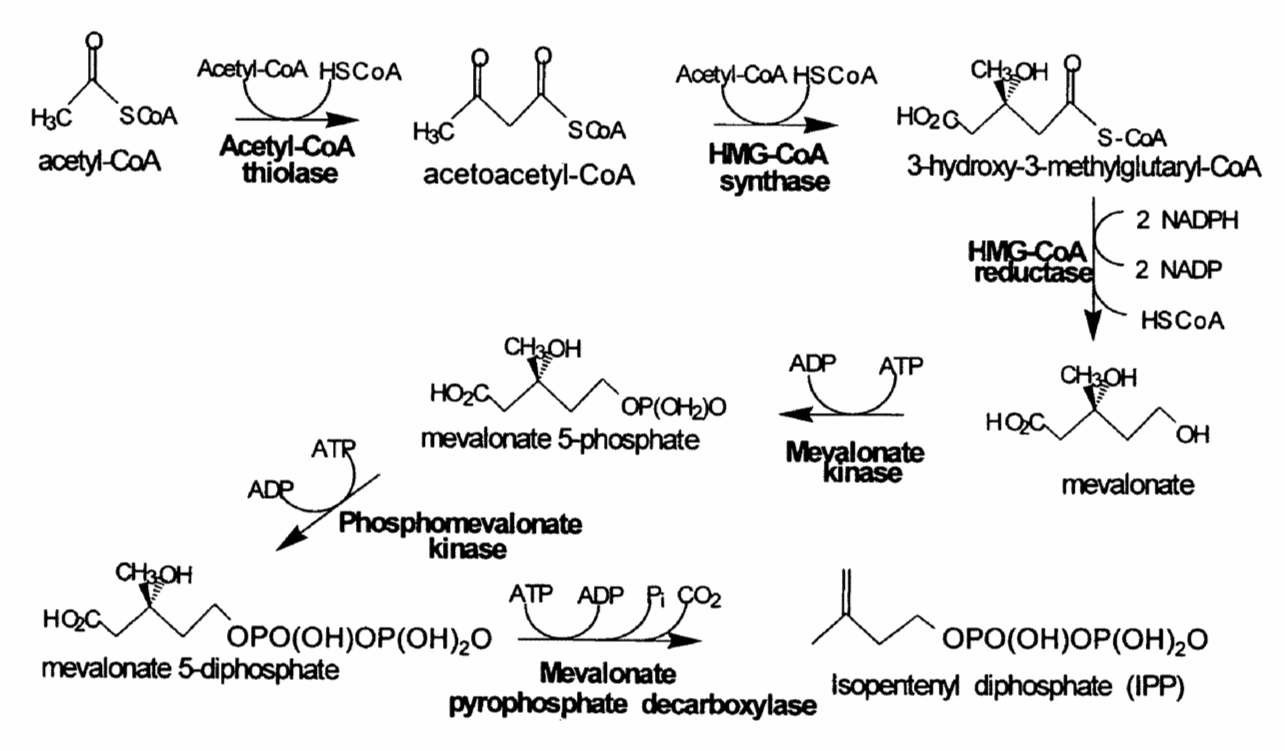
One of the most recent patents granted to Amyris Biotechnologies, Inc. in the area of alternative jet fuel is patent number 7,942,940, “Jet fuel compositions and methods of making and using same”, issued on May 17, 2011 to Neil Renninger, Jason  Ryder, and Karl Fisher. Related US patents of the same title are 7,935,156 and 7,671,245. The ‘940 patent is assigned to Amyris Biotechnologies, Inc. of Emeryville, CA, and is one of 16 presently owned by the company.
The ‘940 patent is classified in the US Patent Classification system (USPC) as 44/300, which covers liquid fuels (excluding fuels that are exclusively mixtures of liquid hydrocarbons), under Class 44 fuel and related compositions. This invention falls within the Energy category of Way Better Patents cleantech ecosystem.
As of 12/5/11, 165 patents are listed in 44/300. The earliest patent issued with 44/300 as the original classification (USPTO-speak for the core inventive subject matter of the patent) is 1,575,437, issued on March 2, 1926.
Claim 1 states:
“A fuel composition comprising or obtainable from a mixture comprising:
 (a) a C.sub.10 bicyclic isoprenoid; (b) a petroleum-based fuel; and (c) a fuel additive, wherein the amount of the C.sub.10 bicyclic isoprenoid is at least about 2 vol. % and the amount of the petroleum-based fuel is at least about 5 vol. %, both amounts based on the total volume of the fuel composition, and wherein the fuel composition has a flash point equal to or greater than 38.degree. C. and a density at 15.degree. C. from about 750 kg/m.sup.3 to about 850 kg/m.sup.3, and wherein where the C.sub.10 bicyclic isoprenoid is pinane, the fuel composition comprises from 0% to 10% of a hydrogenated naphthalene-containing material.”
The ‘940 patent yields jet biofuel produced in part from microorganisms; more than 80 microbial genera or species that can be used in this innovative clean technology process are listed in the specification. You may have heard of some of them:
  • Aspergillus — bread and potato mold; basement mold & mildew.
  • Bacillus subtilis — soil inoculant in horticulture and agriculture; laundry detergent additive.
  • Candida albicans — fungus that grows both as yeast and filamentous cells and a causal agent of oral and genital infections in humans.
  • Escherichia coli — bacterium that is commonly found in the lower intestine of warm-blooded organisms (endotherms). Most E. coli strains are harmless, but some can cause serious food poisoning in humans and are occasionally responsible for product recalls.
  • Fusarium graminearum — plant pathogen which causes devastating disease on wheat and barley, responsible for billions of dollars in economic losses worldwide each year.
  • Lactobacillus helveticus — most commonly used in the production of American Swiss cheese and Emmental cheese but is also sometimes used in making other styles of cheese, such as Cheddar, Parmesan, romano, provolone, and mozzarella. The primary function of L. helveticus culture is to prevent bitterness and produce nutty flavors in the final cheese.
  • Penicillium — members of the genus produce penicillin, a molecule that is used as an antibiotic, which kills or stops the growth of certain kinds of bacteria inside the body.
  • Saccharomyces cerevisiae — perhaps the most useful yeast, having been instrumental to baking and brewing since ancient times; believed to have been originally isolated from the skin of grapes. Antibodies against S. cerevisiae are found in 60–70% of patients with Crohn's disease and 10–15% of patients with ulcerative colitis. Used in brewing beer as a top-fermenting yeast.
  • Salmonella enterica — Most cases of salmonellosis are caused by food infected with S. enterica.
  • Shigella dysenteriae S. dysenteriae, spread by contaminated water and food, causes the most severe dysentery because of its potent and deadly Shiga toxin, but other species may also be dysentery agents. Contamination is often caused by bacteria on unwashed hands during food preparation, or soiled hands reaching the mouth.
  • Staphylococcus aureusS. aureus can cause a range of illnesses from minor skin infections, such as pimples, impetigo, boils (furuncles), cellulitis folliculitis, carbuncles, scalded skin syndrome, and abscesses, to life-threatening diseases such as pneumonia, meningitis, osteomyelitis, endocarditis, toxic shock syndrome (TSS), bacteremia, and sepsis. Methicillin-resistant S. aureus, abbreviated MRSA, is one of a number of greatly-feared strains of S. aureus which have become resistant to most antibiotics.
The patent does point out that non-pathogenic strains are preferred.
Thus, if the technology protected in this patent reaches commercial application, your future holiday air travel could be fueled, in part, by the action of microbes which can be our friend (bread, cheese, beer, penicillin, jet fuel) or foe (mildew, infections, dysentery, MRSA).
Food for thought, so to speak.