Showing posts with label clean technology. Show all posts

Tuesday, April 10, 2012

patentECO - Environmentally Friendly


Environmentally Friendly Energy From Natural Gas

In keeping with my recent energy/natural gas theme, I offer for your consideration Patent Number 7,281,590.
Issued on October 26, 2007, along with 3,507 other patents that issued that day (including one for a “Petunia plant named ‘Kersamfan’ ”), the “Environmentally friendly method for generating energy from natural gas” invention of Wouter Willem van de Waal (Rotterdam, Netherlands) presents subject matter exactly as stated in the title. The patent, assigned to Dropscone Corporation N.V. (Willemstad, Curacao, Netherlands Antilles) is considered by the USPTO as a patent for a well in which CO2 or carbonated gas is inserted, being classified as USPC 166/402.
Claim 1 focuses on preventing soil subsidence of a natural gas well:
“A method for producing energy from natural gas in a natural gas reservoir and preventing soil subsidence in the natural gas reservoir, comprising the steps of:
a) admixing an oxygen containing gas with the natural gas and converting said oxygen containing gas and said natural gas in the presence of CO.sub.2, into a flow comprising CO.sub.2 and water, whereby energy is generated
b) removing at least a part of the water from the flow comprising CO.sub.2 and water, so that a gaseous product flow is obtained;
and c) injecting at least a part of said product flow into the natural gas reservoir from which the natural gas has been extracted characterized in that, said oxygen containing gas has a nitrogen content substantially lower than air, wherein injecting at least a part of said product flow into the natural gas reservoir substantially prevents soil subsidence in the natural gas reservoir.”
By combusting natural gas in the presence of a a mixture of oxygen and carbon dioxide, heat, water, and carbon dioxide are produced. The inventor proposes injecting at least part of the carbonated water back into the well, which prevents soil subsidence, and allows the recovery of geothermal energy, which can be used to either heat the natural gas prior to combustion or feed heat exhangers for other purposes.
Properly considered a cogeneration technology, this invention is found in he patentECO Energy Index.

Thursday, March 22, 2012

patentECO - Add Carpet and Stir...Alternative Concrete


Alternative Concrete
We offer a generic concrete recipe:
  • 4 parts gravel
  • 2 parts sand
  • 1 part Portland cement and water
  • Mix ingredients, pour into forms, and allow to set.
Various forms of concrete have been used since the times of the Assyrians, Babylonians, Egyptians, and Romans. Concrete is one of the strongest, and most widespread, building materials. Its manufacture and use offer opportunities to apply clean technology from multiple patentECO indexes such as Air, Energy, Industry, Extraction & Harvesting, and Water.
Inventors James Glessner (Santa Rosa, CA), Richard McCabe (Occidental, CA), and Meredith Ware (East Palo Alto, CA) offer a glimpse of how concrete can be more efficiently made. Their invention, patent number 7,727,327, is a “Low embodied energy concrete mixture.” Awarded on June 1, 2010, the patent is classified as 106/644 which includes inventions dealing with fiber, bar or wire containing compositions within the coating or plastic compositions technologies. Why would cleantech concrete be found here?
It all depends on how the technology class, in this case Class 106 Compositions: Coating or Plastic, is defined by the USPTO. Their definition states:
“This class is the broad generic class for:
(1) Coating, impregnating or plastic compositions, especially those which set or harden to retain a given shape. Most of the compositions herein found are those which are capable of undergoing a change from a fluent to a nonfluent condition, or from a solid noncoherent form to a solid coherent form, which changes may be effected in any or more of the following ways:
  1. By setting, e.g., concrete . . .”
Glessner et al. claim:
“1. A cementitious mixture comprising: Portland cement; fly ash; silica fume; recycled aggregate; ground recycled carpet fibers; organic fibers; and water.”
This claim gets us into clean technology via “recycled aggregate; ground recycled carpet fibers; organic fibers . . .”
They further claim (claim number in parentheses) that 
  • the ground recycled carpet fibers comprise nanoparticles (2)
  • the recycled aggregate comprises crushed, recycled concrete (3), recycled glass (4), crushed concrete and bricks (5)
  • the organic fibers are rice hulls and other natural waste fibers (7)
  • ground granulated blast furnace slag (8), lime kiln dust (12), or cement kiln dust (16) is substituted for some of the Portland cement
  • a high range water reducer (20) is added to the mixture.
The inventors’ intention is to reduce the amount of energy needed to manufacture concrete by substituting recycled materials for Portland cement, which requires large amounts of energy to make. The use of recycled materials substituted for aggregate reduces the amount of virgin aggregate that would otherwise need to be mined. Assuming that the strength characteristics of the concrete made according to the invention are satisfactory for the intended use, this appears to be a multiple win-win clean technology innovation.


Tuesday, March 13, 2012

patentECO - Fracking and Waste Water Treatment


Hydraulic Fracturing and Waste Water Treatment - Part 1
The US Energy Information Administration estimates that US potential natural gas resources total 2543 trillion cubic feet (tcf), with shale gas deposits contributing 862 tcf (34 percent) of this total. At 2010 consumption rates (about 24.1 tcf), the estimated reserve could supply more than 100 years of use. In the eastern US, the Marcellus shale formation extends from New York through Pennsylvania, western Maryland, virtually all of West Virginia, and includes portions of western Virginia and eastern Ohio, and is generally 4000-8500 ft below ground surface. This is far below the aquifers that supply well-water for drinking. It is estimated by researchers Terry Englander, a geoscience professor at Pennsylvania State University, and Gary Lash, a geology professor at the State University of New York, to contain about 50 tcf of recoverable natural gas.
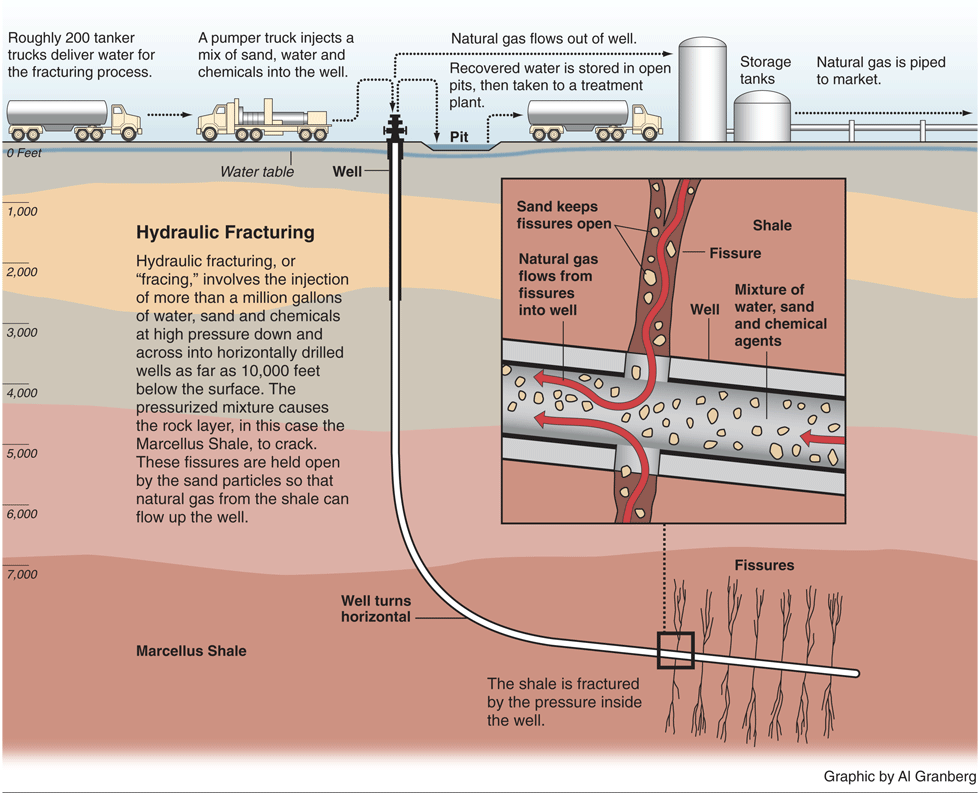
As with any resource extraction activity, concerns have been expressed regarding the procedures used and their actual or potential environmental impacts. In the case of shale gas production, a major concern is related to the hydraulic fracturing used to open cracks in the shale which allow the natural gas to be more efficiently collected. A central focus is on both the volume of water needed for the “fracing” process, the chemicals used, and the potential for groundwater contamination and spills of the waste water water to surface streams and rivers.
The hydraulic fracturing process injects water, sand, and other ingredients at very high pressure into the well. The high pressure creates small fractures in the rock that extend out as far as 1,000 feet away from the well. After the fractures are created, the pressure is reduced. Water from the well returns to the surface (known as flowback), but the sand grains remain in the rock fractures, effectively propping the fractures open and allowing the gas to move. Most frac fluid used in shale gas wells consists of water, a proppant (generally sand), a friction reducing agent (to help the flow-back water return from the well at the end of the frac job), and other chemicals used to protect the well and to optimize performance.
The US Department of Energy estimates that for a typical well in the Marcellus formation, 80,000 gallons of water are needed for well drilling, and 3.8 million gallons for fracturing. Water and sand comprise more than 98 percent of the fracing fluid. 30-70 percent of the fracing fluid returns to the surface as flowback. Thus, there is a large volume of contaminated water from each natural gas well that must be treated in some fashion.
In my next post, we’ll review recent innovations found in Way Better Patents Water Index that apply to the water used in hydraulic fracturing operations.

Thursday, March 8, 2012

patentECO - Wind & Water


US Patent 6,023,105
Hybrid Energy — Water & Wind

Grid energy storage, or large-scale energy storage, if you prefer. It’s one of the phrases you hear bandied about in discussions of alternative energy, solar and wind power, and other forms of non-continuous energy generation and refers to ways of storing electricity on a large scale within a power grid. The only currently available, fully operational, efficient, and widely used grid storage technology is pumped storage hydroelectricity.

Hydropower produced 31 percent of the total renewable energy consumed in the US in 2010, according to the US Energy Information Agency. Wind produced 11 percent. What would happen if you coupled water and wind energy generation technologies?

Wasfi Youssef (Mamaroneck, NY) obtained patent number 6,023,105, “Hybrid wind-hydro power plant,” on February 8, 2000. The patent is classified as a prime-mover dynamo plant including a fluid-current motor (290/54). There are currently (early January 2012) 749 patents in this innovation space within the patentECO Energy Index.

Claim 1 states:

“A hybrid wind-hydro power plant in which a difference between two water levels is utilized to generate an electrical power, comprising:

a first water reservoir located at a high level;

a second water reservoir located at a low level;

an equipment for pumping water from said second low reservoir to said first high reservoir consisting of: (a) a water pump positioned in said second reservoir for pumping water to said first reservoir, (b) a penstock from said pump to said first reservoir, which has a non-return valve to allow water flow upstream but not downstream, and (c) a windmill with a rotational shaft coupled directly to said water pump to rotate said water pump and act as a prime mover for said water pump;

a hydraulic turbine installed to receive water via penstock from said first reservoir and to discharge said water to said second reservoir and to convert said water's kinetic energy into mechanical energy of turbine rotation;

an electrical generator coupled to said turbine and rotated by said turbine to produce electrical energy.”

Youssef intends that wind-driven pumps lift water from downstream, or the tailwater area of a hydropower station, to upstream, or headwater. An adjustable weir constructed downstream the water pump holds the water discharged from the turbine and creates a pool or lake from which water can be pumped. The weir can be lowered or raised, allowing the water flow can be managed to suit the wind and the hydropower plant operation.

Another application of his invention is at sites where the wind is strong and there are two nearby waterbodies separated in elevation. The wind-driven water pumps lift water from low elevation to high elevation, where it is stored until used by the hydropower plant to generate electricity. In this application, a hydropower plant is needed, but a dam and adjustable weir are not needed.

Any type of windmill can be utilized, although a vertical-axis type is preferred by the inventor to a horizontal-axis windmill. The former requires fewer connecting components and its tower is much smaller than that of the horizontal-axis type. On the other hand, the horizontal-axis type can be built in larger units and can be more efficient.

The world’s largest pumped hydro facility lies in Bath County, VA, and generates 3,003 MW of power for Dominion. In recent years there has been much interest expressed by wind energy developers to create large mountain-top wind farms in that part of Virginia  and adjacent West Virginia. Will the Bath County pumped storage station become a water and wind hybrid?

Tuesday, March 6, 2012

patentECO - Lots of Holes


Four Thousand Holes
“I read the news today oh boy
Four thousand holes in Blackburn, Lancashire
And though the holes were rather small
They had to count them all . . .”
These lyrics, by John Lennon and Paul McCartney, from the last verse of “A Day in the Life” on the classic 1967 album Sgt. Pepper’s Lonely Hearts Club Band, were inspired by an article they read in the January 7, 1967 UK Daily Mail about . . .
. . . potholes.
Much of the U.S. will soon be moving into pothole repair season. What a treat it is to hit one at speed in traffic on an interstate. Potholes are pretty mundane, but represent a non-trivial source of annual vehicle repair costs to US motorists. A 2009 report by the the American Association of State Highway and Transportation Officials, and TRIP entitled “Rough Roads Ahead, Fix Them Now or Pay for It Later” estimates that rough roads add $335 annually to typical vehicle operating costs, and may be as high as $746 in urban areas with high concentrations of rough roads.
So what does the Beatles’ song “A Day in the Life”, and a report about rough roads have to do with patentECO and clean technology innovations?
Three patents, as examples.
Patent number 6,984,670, “Recyclable composite materials articles of manufacture and structures and method of using composite materials,” was issued on January 10, 2006 to John J. Meyers, III (Penfield, NY), John H. Swartz (Coraopolis, PA), and Nathaniel G.  and Matthew J. Kurczewski (Moon Township, PA) and assigned to Ace Tire & Parts, Inc. (Coraopolis, PA). The patent is classified (521/50 with other inventions that deal with a process of treating scrap or waste product containing solid organic polymer to recover a solid polymer therefrom, which lies within a broad class accepting synthetic resins or natural rubbers.
The invention uses a composite material using recyclables (glass, polymers, plastics, rubber, both fiberglass and asphalt roof/siding shingles, coal combustion by-products, metals) and that does not contain newly added petroleum products or new, non-recycled chemicals. This material may be used to fill potholes in asphalt and concrete pavement, fill manhole cover recesses, to make expansion joints in roadways, and in building materials, such as, for example, building blocks, structural panels and other structural elements including pipes and fixtures.
Patent number 6,652,185, “Fast efficient permanent pavement repair material system,” was issued on November 25, 2003 to William D. Frey of Leawood, KS. Frey’s invention can be found with others that provide a reinforced structure in a road structure, process, or apparatus (404/70).
Frey’s innovation provides a repair composite for pavement and pothole repair. The repair composite is composed of an a polyester casting resin premixed with dry silica sand, cobalt in combination with dimethylanaline, and a catalyst. How is this clean tech? According to the invention summary, “[t]he use of this composite will eliminate the use of most of the heavy equipment normally used in road repair.”
Patent number 6,588,973, “Pavement method and composition with reduced asphalt roofing waste,” was invented by James S. Omann (Rogers, MN), and granted on July 8, 2003. The invention deals with pavement aspects of a road structure, process, or apparatus (404/17).
Omann has invented a method of manufacturing and applying a novel pavement and patch material for roadways, driveways, walkways, patch for potholes and like surfaces, including the steps of reducing recycled asphalt roof waste to granules, adding aggregate and other solid recyclable materials to the granules, adding rejuvenating oil, adding emulsifier, adding asphalt concrete oil, adding anti-strip additives, adding liquid silicone, mixing the composition, heating the composition, applying the composition to the roadway or the like and compacting a new paving material.
These inventions fall within the recycling aspect of the patentECO Industry Index, but also within the road construction materials and techniques components of the Transportation Index.
And the lyrics at the top of this piece are found within the great music index.


Tuesday, February 28, 2012

patentECO -- Low Tech Clean Tech


Low Tech Clean Tech

What comes to mind when you hear the phrase “clean tech”? Advanced, complex water or wastewater treatment facilities? Extensive wind energy farms? Clean rooms where solar panel technology is constructed? Hybrid fuel cars?

What about a PVC or concrete pipe 39-48” long, 16” in diameter containing a layer of fine sand over gravel?

Patent number 5,993,672, “Slow sand filter for use with intermittently flowing water supply and method of use thereof,” was granted on November 30, 1999 to David Manz of Calgary, Canada, and assigned to University Technologies International Inc., the technology transfer arm of the University of Calgary. The patent is classified as 210/744, which places it with inventions dealing with level sensing aspects of liquid purification or separation technologies.

Claim 1 of the patent states:

“A method of operating a slow sand filter for use with an intermittent supply of water, the filter including a container, filter material partially filling the container and having a top, a water inlet above the filter material and a water outlet within the filter material, the method comprising the steps of:

supplying an intermittent flow of water to the container; and

maintaining the water level in the container above the top of the filter material even when there is no flow of water through the slow sand filter at a maintenance level that is selected such that (1) water falling onto the water in the container does not disturb a schmutzdeuke layer formed on the top of the filter material and (2) the schmutzdeuke will survive even when there is no flow of water through the container for at least 24 hours.”

A “schmutzdeuke layer”? What in the world (at least we assume it is not alien) is that? “Schmutzdecke” is a German word that translates as “dirty layer.” If you look in the Background and Summary of the Invention section of the patent (which follows the claims), Manz defines the “schmutzdeuke layer” as a biological layer that forms at the top of sand when the sand is immersed in flowing water for several days. The schmutzdeuke is formed from various organisms such as algae, plankton, diatoms, protozoa and bacteria. It entraps and partially digests and breaks down organic matter container in the raw water passing through the filter. The organic matter accumulates on the schmutzdeuke and simple inorganic salts are formed. At the same time, inert suspended particles in the raw water are removed mechanically. You can see this reddish-brown layer if you have a sand-filtered aquarium. Think of it as a living version of a coffee filter.

Slow sand filters are effective in removing bacteria, parasites, Giardia cysts, Cryptosporidium oocysts and viruses from water. In fact, sand filters might be a major component of the water treatment plant that provides your drinking water if you are on a municipal water system. While bacteria, parasites and viruses may be killed or rendered inactive with disinfection, dormant cysts and oocysts are very resistant to disinfection unless the disinfectant is administered very intensively. Slow sand filters may be used to supply clean water directly for consumption or may be used to supply water for further treatment, such as by reverse osmosis and ultra-filtration, both of which processes require quite clean water to begin with.

Manz’s invention, by providing a static water level above the sand layer, allows the biosand filter to be used in situations where the water supply is intermittent (the biological filter layer dies if it dries out), such as wilderness cabins, third-world countries, and disaster settings.

Simple technology, such as this one in patentECO’s Water Index, can be clean.


Thursday, February 23, 2012

patentECO - Water on the Move


Power From Flowing Water

The American Water Works Association reports that water systems are evaluating applying smart grid technology to the treatment, distribution, and monitoring of drinking water. Recent patents support this development.

Patent number 7,605,485, “Systems and methods for generating power through the flow of water,” was issued October 20, 2009 to Barth Robins Pitchford (Fairfax, VA), William Dudley Pitchford (Fairfax, VA), Robert Paul Simon (Fairfax, VA), C. David Binning (Warrenton, VA), and David Lewis Rasmussen (Vienna, VA) and was assigned to the Fairfax County (Virginia) Water Authority. The patent is classified as 290/43 for prime-mover dynamo plants, and specifically fluid current motors. As of January 5, 2012, this subclass contains 524 patents related to hydroelectric, wave, and wind power generation, among others.

The FCWA is Virginia’s largest water utility, serving one out of every five Virginians who obtain their water from public utilities. Nearly 1.7 million people in the Northern Virginia communities of Fairfax, Loudoun, Prince William and Alexandria obtain their drinking water from FCWA.

Claim 1 states:

“A power generator system comprising:

a rotating device adapted to rotate in response to a flow of water on the rotating device;

a drive magnet operatively coupled to the rotating device and adapted to rotate in response to the rotating device rotating;

a registration magnet operatively coupled to the drive magnet and adapted to rotate in response to the drive magnet rotating;

a power generator operatively coupled to the registration magnet and adapted to harvest and store energy in response to the registration magnet rotating;

a rectifier operatively coupled to an output of the power generator and adapted to convert the energy from an alternating current (AC) to a direct current (DC);

a first power storage device adapted to be charged by an output of the rectifier and a second power storage device adapted to be charged by an output of the first power storage device;

and a processor configured to monitor voltages levels of the first power storage device and second power storage device and cause a transfer of energy from the first power storage device to the second power storage device in the event that the voltage level of the first storage device is above a first threshold and the voltage level of the second storage device is below a second threshold.”

This invention generates and harvests energy in response to the flow of water through rotating device, such as a nutating or oscillating disk. Mechanical energy from flow of water is converted into electrical energy via an energy conversion unit. The power generation system may be used to power electronic and mechanical devices used in automated meter reading (AMR) systems. The power generator system may recharge a storage circuit that enables long term AMR operations without the need for battery replacement. The power generation system, in various embodiments, can provide additional power for two-way communication and other sensors such as pressure, temperature, water quality and services such as remote shut-off, event-based messaging, and water quality monitoring.

These inventors and assignee also were granted patent number 7,671,480, “Systems and methods for remote utility metering and meter monitoring,” issued March 2, 2010. This patent is also classified as 290/43. The patent is a divisional of the application that led to the ‘485 patent. A divisional patent application occurs when a patent examiner determines that a patent application describes more than one invention (a patent can only describe one invention). The original patent application is "divided" into a new application referred to as a divisional patent application.

These types of inventions are a component of the emerging smart water grid. They also illustrate linkages between patentECO indexes, in this case, Energy and Water.


Tuesday, February 21, 2012

patentECO - Green Snow Removal


I Don’t Mind Snow, But I Can Do Without Ice

As I write this article in very early 2012, it is snowing here in Virginia’s Shenandoah Valley. A nice, gentle dusting of snow. Very unlike the Snowmageddon of 2009-2010. I’ve seen no indication of any snow removal equipment yet this morning, which reminds me, what about clean snow removal technology in the patentECO sphere?

For many years, various mixtures of grit and rock salt have been used on highways for snow removal and ice control. More recently, chemical compounds and mixtures that have a lower negative environmental impact and greater melting efficiency have been used.

Two recent patents illustrate this shift.

Patent number 7,879,254, “Snow removal agent and preparation method,” was issued on February 1, 2011 to Seung Cheol Jung and Moo Woong Jung, both of Incheon, South Korea. This patent is a continuation of patent number 7,666,324, “Snow removal agent and preparation method thereof,” issued the previous February 23 to the same inventors. Both patents are classified as 252/70, which are inventions for frost-preventing, ice-thawing, thermostatic, thermophoric, or cryogenic compositions.

The earliest US patent in this class and subclass was patent number 533,950, “Composition for melting snow,” issued in February, 1895. This early invention used a combination of water, common salt, acetic acid, and hydrochloric acid — perhaps not the best combination if one is interested in reducing environmental impacts.

Claim 1 of the ‘254 patent states:

“A snow removal agent for melting snow, comprising magnesium chloride, halite, urea, sodium tripolyphosphate and sodium metasilicate, wherein the sodium tripolyphosphate and the sodium metasilicate each account for an identical weight percentage in the agent, wherein the halite is crushed to a size of 7-20 mm and aged for 24-48 hours.”

Jung and Jung point out that their invention “reduces the corrosion of metallic materials of iron structures, automobiles, etc., is safe when used for a long period of time, is without the problem of re-freezing, significantly reduces the yellowing and withering of plants and is good for the growth of plants . . .” Further, their snow removal agent is “unharmful to plants, fish and shellfish.”

We find this invention in the patentECO Industrial index, which includes green chemistry and clean industrial technology. The slogan used by DuPont from 1935-1982, “Better Things for Better Living . . . Through Chemistry” certainly fits here.

Thursday, February 16, 2012

patentECO - Is Your Garden Clean or Green?


Is your garden clean and green?
It’s time to think of gardening. One of the tricks known for many years to get an early start on fresh vegetables is to warm the soil. Another related trick to increase your garden’s yield is to limit weed growth and competition for soil nutrients.
How are these gardening techniques related?
Plastic mulch.
Uri Peled (Zichron Yaakov, Israel) and Karl Heinz Bartnig (Ruethen, Germany) were issued patent number 6,601,338, “Plastic film for use in agriculture”, on August 5, 2003. The patent is classified as 47/9, which is Plant husbandry, mulching.
Claim 1 of the invention states:
“A polymeric, multilayer, photoselective mulch film for use in agriculture, Comprising at least two layers, an upper layer facing the sky and a lower layer facing the ground, each of said layers being of a different color, and each being light-transmissive;
wherein said upper layer is of a color which repels insects, and said lower layer is of a color whereby the solar radiation transmitted by said film and reaching the ground is of such a spectral composition as will largely deprive weeds of essential photosynthetically active radiation, while having a spectral component that will be absorbed by, and will heat, the ground.”
That’s pretty self-explanatory. There are obviously other inventions related to mulching of garden and commercial crops. These inventions are found in the agriculture domain of patentECO.
You might be interested to also learn of the two earliest clean tech patents for mulching technology.
The earliest was patented in 1867, by William Griffith of North East, PA. His invention, patent number 64,760 entitled “Mode of propagating grape-vines from single buds in the open field,” claimed “[t]he mode of propagating grape-vines, substantially as set forth, in open-field culture, by covering single bud cuttings with a cold mulch, applied in sufficient depth to keep down the temperature of the bud, and thereby retard its sprouting until the roots have been adequately developed.” His preferred mulch was a two-inch covering of “sawdust, tan [this was the depleted bark from leather tanning operations], or other suitable material.” His intention to increase crop yield through better bud propagation, and his use of sawdust or depleted leather tanning bark as the mulch, all qualify as clean tech, in two different domains, in fact. Agriculture (yield enhancement) and Industry (recycling).
The second oldest mulching patent was number 80,053, “Improved mode of mulching strawberry-beds”, issued in 1868 to Joseph Brett of Geneva, OH. Brett’s invention, also intended to enhance crop yields, relied on planting his own mulch: “The mode of mulching strawberry-beds by sowing thereon the seeds of plants [he preferred oats, but “other plants of analogous character may be used.”], the stalks or blades of which are intended to serve as a mulch therefor, substantially as set forth.” Again, clean tech in multiple domains.
Much of what we consider now to be clean technology is old clean technology with new packaging or using newer materials.


Tuesday, February 14, 2012

patentECO - Indoor Wetlands


A December 26, 2011 Associated Press article discussed challenges faced by many cities to control overflows due to wet weather from combined municipal stormwater and wastewater systems. The article references a USEPA memo released in late October, 2011 describing an integrated planning approach that EPA will implement with municipalities to look for opportunities to solve multiple water quality problems. EPA’s announcement of the planning approach touts “[g]reen infrastructure, such as green roofs, rain gardens, planter boxes, and permeable pavement, [as] an example of an integrated solution that can reduce, capture, and treat stormwater runoff at its source before it can reach the sewer system. Green infrastructure provides a cost effective way to reduce overflows and add green space in communities.”
Some of the technologies mentioned by EPA fall into the patentECO Industry ecosystem (e.g., green roofs, rain gardens, planter boxes) while others are transportation-related (permeable pavement). Is there other, more advanced patented clean technology that can be brought to bear on reducing stormwater runoff or pollution in towns and cities, thereby also reducing the potential for overflowing sewage from their combined treatment facilities?
The “greenest” technologies to accomplish this would use living, green plants. It has long been known in ecology that wetlands have a tremendous capacity for buffering storm runoff (and wave action in the case of tidal wetlands) and absorbing and/or converting water pollutants to less toxic or available forms. Early work to apply this knowledge to the treatment of polluted water occurred in Germany in the 1950s. In the US, a number of patents using this knowledge have been granted to John H. Todd:
5,087,353: “Solar aquatic apparatus for treating waste”
5,389,257: “Methods for treating water”
5,486,291: “Ecological fluidized bed method for the treatment of polluted water”
5,618,413: “Ecological fluidized bed system”
Todd’s patents were purchased in 1999 by Worrell Water Technologies of Charlottesville, VA. Worrell has updated the technology and received additional patents.
Patent number 7,320,752, “Integrated hydroponic and wetland wastewater treatment systems and associated methods”, was issued on January 22, 2008 to David C. Austin, David J. Maciolek, and J. Rob von Rohr. The invention is classified in the US system as 210/602; this places it with technology that uses plants or animals of a higher order (i.e., not bacteria) to purify or separate liquids. 
Claim 1 states:
“A method for achieving advanced treatment of wastewater comprising:
removing from water to be treated at least some organic compounds and solids in a first module;
at least intermittently exposing the water to be treated to oxygen in the first module;
achieving at least partial denitrification of the water to be treated in the first module;
channeling the water from the first module to a second module comprising an aerated hydroponic reactor;
and channeling water exiting the hydroponic reactor to a top of a third module comprising a vertical-flow wetland adapted to maintain a population of aquatic invertebrates therein, for achieving BOD removal, nitrification, denitrification, and removal of TSS.”
Worrell’s other patents for this technology include:
7,347,940: “Nitrogen removal system and method for wastewater treatment lagoons”, issued March 25, 2008.
7,378,021: “Tidal vertical flow wastewater treatment system and method”, issued May 27, 2008.
The upshot of these patents is that if you are a building owner interested in reducing the environmental impact of your property, and you desire to improve water quality, the technology to do that with constructed ecosystems exists. It would even make a fascinating addition to your building’s lobby.

Thursday, February 9, 2012

patentECO - A Guitar-Tuning Flashlight


I recently perused a musical supply catalog and saw a listing for “the world’s first chromatic green [guitar] tuner.” The description of this clean tech device went on to say that the user can “[s]imply give the crank a few turns and you’re ready to tune. No more expensive and wasteful batteries . . . [t]he built-in flashlight lets you tune on a dark stage.”
Of course, the ad doesn’t mention that one could use rechargeable batteries, but let’s not quibble. We can agree that using human-supplied mechanical power to turn the crank to supply the small (my tuners require 2 AAA batteries for a total of 3 volts DC) amount of power needed by this device is clean technology, good for the environment, conserves the metals and other material used for the eliminated batteries, reduces the amount of fossil fuels combusted or nuclear fuel reacted to charge the batteries, and, multiplied by the sale of millions of these tuners, represents one small step on the road to a clean tech society. We would find this tuner in the Energy area of the patent ecosystem.
And because it’s clean tech, and labelled a “green” product, it’s completely new and different, right?
Ah, no, not exactly.
Patent number 252,691, “Combined electric lamp and generator,” was issued on January 24, 1882 to Elizabeth Morey of New York, NY. The invention is classified as 362/192 in the USPC, a class and subclass covering illumination with a generator power source. The purposed of Morey’s invention is “to furnish a portable electric lamp for domestic and business purposes, which is directly combined with its generator, so as not to be dependent upon a central station for the current . . .” The lamp contains “a small dynamo-electric machine or current-generator . . .” Attached to the motor is a “convolute spring and winding-up devices — a motive power of sufficient power to actuate the current-generator.”
Also relevant to the hand-cranked green guitar tuner with flashlight is patent number 983,742, “Electric hand lamp.” Issued on February 7, 1911 to John W. Mead of Buffalo, NY, this patent is also classified in 362/192. Of historical note, this patent was issued exactly one week before patent number 984,519 to John M. Browning.
Mead describes his invention: “The current for lamps of this character has heretofore been furnished by dry batteries located in the handle of the lamp. Inasmuch as such batteries are necessarily small they soon become exhausted and require frequent renewal, thus involving constant expense for maintenance. It is the object of this invention to produce an electric hand lamp containing a magneto for generating the current for lighting the lamp, the body of said lamp having preferably the form of a pistol or revolver and the armature being operated by a trigger in substantially the same manner in which a pistol is fired.”
Much of what we see as new, clean technology in the patentECO patent ecosystem is the re-purposing of old technology in more efficient ways, for new uses, or with new materials. Prior art matters.

Tuesday, February 7, 2012

patentECO - Green Investing in Brown Fields


On December 19, 2011, Fox News reported that “EPA Ponders Expanded Regulatory Power In Name of 'Sustainable Development'”. The report links current EPA thinking on sustainable development with the United Nations’ Rio+20 Conference on Sustainable Development and an August, 2011 National Academy of Sciences study entitled “Sustainability and the U.S. EPA.”
Sustainability is based on a simple principle: Everything that we need for our survival and well-being depends, either directly or indirectly, on our natural environment.  Sustainability creates and maintains the conditions under which humans and nature can exist in productive harmony, that permit fulfilling the social, economic and other requirements of present and future generations.
Sustainability is important to making sure that we have and will continue to have,  the water, materials, and resources to protect human health and our environment.
And what is USEPA doing about it? In a sentence from the previous link:
Today EPA aims to make sustainability the next level of environmental protection by drawing on advances in science and technology to protect human health and the environment, and promoting innovative green business practices.
Are there patents covering sustainable development?
Here’s one. Patent number 7,346,572, “Brownfields investing”, was issued on March 18, 2008 to Cheryl Hoffman (Golden, CO) and assigned to CLHSM, LLC (Denver, CO). Brownfields is the term used for former industrial or commercial sites where future use is affected by real or perceived environmental contamination.

The Hoffman invention is classified as 705/37 in the US Patent Classification system. Patents that claim trading, matching, or bidding within a finance framework are found here — this is a business method patent. It is found within the Industry category of patentECO’s clean technology patent ecosystem.
Claim 1 states:
A method for managing a Brownfields fund, comprising:
storing in a computer system information relating to the Brownfields fund;
accepting investor capital from at least one investor into the Brownfields fund;
storing information in the computer system relating to the at least one investor, the stored information including investor identification information, investment amounts, and terms of investments;
storing information in the computer system concerning an entity and a Brownfields project, the entity having an ownership interest in the Brownfields;
approving the entity and the Brownfields project for financing with investment capital from the Brownfields fund according to select criteria using the information stored in the computer system concerning the entity and the Brownfields project;
and providing the investment capital from the Brownfields fund to the approved entity to at least partially finance the approved Brownfields project without taking any ownership interest in the approved Brownfields project, the approved entity being provided the investment capital using at least some of the investor capital from the at least one investor.
According to the inventor, “contaminated properties have been considered a current and future liability to their owners (current and future), and to the communities in which they are located. The market value of real property is directly affected by contamination and pollution. Valuation of real property is negatively effected by risks that are not quantifiable in terms of time and/or money. Valuation affects decision making during cleanup of contaminated property, and, likewise, decision making during remediation affects valuation, of the contaminated property and surrounding properties. The result has been that many of these properties are idle and abandoned in spite of their potential value.”
This invention provides a system and method for investing in brownfields-related projects capable of supporting all aspects of a remediation/development/redevelopment project, while shielding investors from environmental liability.
We tend to think of clean technology as things, when in fact, it includes processes and methods of doing business in ways that use less material and/or energy, minimize waste, or lessen negative environmental consequences. Certainly, financing inventions that provide diminished risk of investing in contaminated properties meets this criterion.