• Agriculture
• Air
• Energy
• Extraction & Harvesting
• Industry
• Transportation
• Water
Curiously, the USPTO’s Green Tech Pilot Program has issued very few patents in the Extraction and Harvesting Index. One of these is US 8,162,049 issued in April 2012 to Peter E. Rose (Salt Lake City, UT) and assigned to the University of Utah Research Foundation. Mr. Rose’s invention, “Injection-backflow technique for measuring fracture surface area adjacent to a wellbore,” provides techniques for using tracer materials as a measurement tool to provide data for an underground reservoir fluid flow model. The model calculates fracture surface area resulting from hydraulic fracturing and geothermal formation stimulation. Increased surface area of fractures correlates with increased energy extraction rates.
The invention is summarized in Claim 1:
A method, comprising:
measuring an initial temperature profile along the length of a wellbore;
injecting a tracer composition into the wellbore at an initial concentration, wherein the tracer composition includes a first thermally reactive tracer and a second thermally reactive tracer, wherein the second thermally reactive tracer is less thermally reactive than the first thermally reactive tracer;
allowing the tracer composition to diffuse within a subterranean reservoir for a time; measuring a second tracer concentration of the second thermally reactive tracer and a first tracer concentration of the first thermally reactive tracer as a function of time; and
calculating a reservoir fracture surface area using the second tracer concentration and the first tracer concentration and thermal decay information of the first thermally reactive tracer and the second thermally reactive tracer.
Claims 4 through 6 provide the types of tracers to be used; these include:
- deuterated water, alkali metals, alkaline-earth metals, halides, and combinations thereof
- 2,6-naphthalene disulfonate
- esters, amines, aryl halides, rhodamine WT, eosin Y, dyes, halogenated fluoresceins, and combinations thereof.
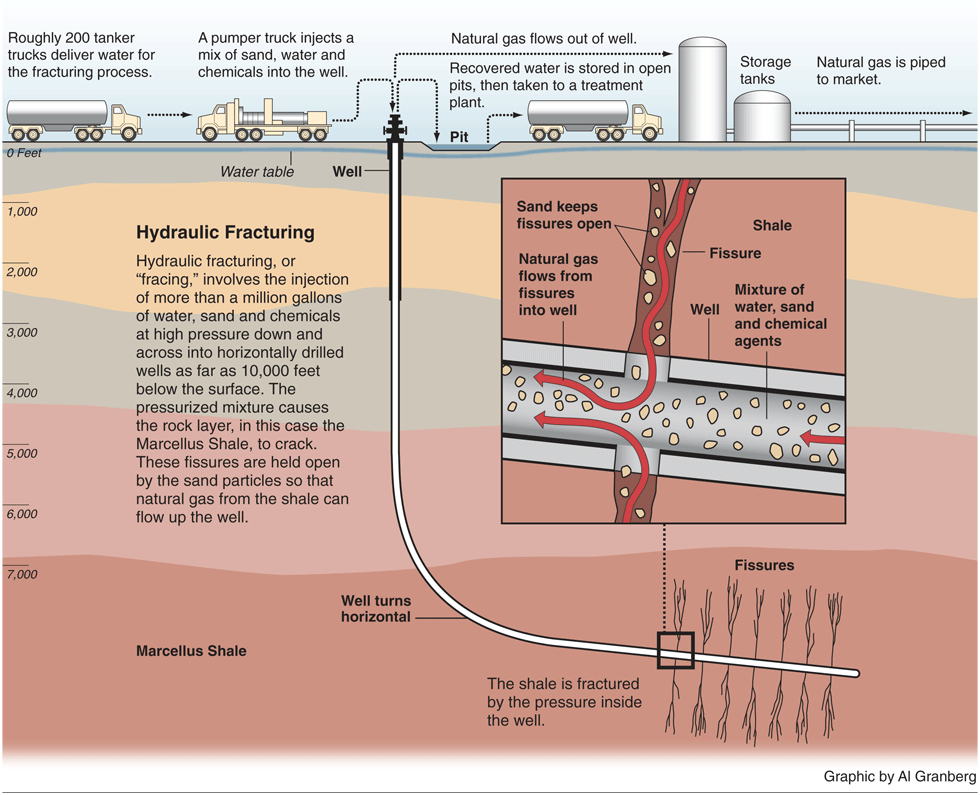
Finally, the subterranean reservoir to which this measurement technique may be applied includes a geothermal reservoir, gas reservoir, oil reservoir, or combination thereof. In other words, the method can be applied to the hydraulic fracturing (aka fracing or fracking) method used in shale gas fields such as the Marcellus and Utica shales.
Mr. Rose’s Figure 1 shows a general engineered geothermal system (EGS 100) including a single injection well 110 and two production wells 120A and 120B. A fluid can be injected into the injection well where the fluid travels through fractures 130 in the adjacent formations outward towards the production wells. In the case of heat recovery, the fluid is heated via natural underground thermal sources 140. The production wells are located such that the heated fluid can be recovered and directed to a suitable heat transfer mechanism for producing power or the like, e.g. steam turbines 150. As the inventor points out, the same hydraulic stimulation method can increase production of any well-based production of energy and/or materials (e.g. natural gas, oil, and the like).
Inventor Rose is one of the innovators whom we can thank for helping to unlock US underground energy sources, provide more efficient means for extracting those resources, and reducing the price of energy for all of us.
A footnote: claim 15 states that “the reservoir fluid flow model is run in a numerical simulation program.” Although the USPTO did not provide a software-related cross reference classification for this claim it refers specifically to software. There has been a steady drumbeat by many bloggers and commentators that software should not be patented. Software, however, is intellectual property, and deserves protection via patents, as do the myriad of other types of inventions found in the patentsphere.