Showing posts with label hydraulic fracturing. Show all posts

Wednesday, March 13, 2013

PBR – Rubber, Not Beer

Source: http://upload.wikimedia.org/wikipedia/commons/c/c6/1,3-Butadiene_Polymerization.PNG


It was always curious  the fear that college organic chemistry engendered in students. Yes, it could wrap your brain around the axle learning the various bond types, transition states, and compound-naming conventions, but come on, gang, it’s fascinating!

A recent posts featured a photo of a stack of tires. The Rubber Manufacturers Association estimates that 292 million tires weighing a total of 4.9 million tons, were scrapped in the US in 2009. The largest percentage of these (40.3%) were disposed of as tire-derived fuel, with the next largest category being ground rubber. For this end-use, molded and extruded products, sports surfacing, playgrounds/mulch/animal bedding, and automotive uses were the descending order of uses. The RMA also estimates that 162 million new tires were manufactured in the US in 2012.

A common thread between tires and your car, the roads you drive on, the tennis courts you play on, surgeries or medical implants and devices you might be treated with, and that evil-of-evils (not!), hydraulic fracturing (aka fracking), is polybutadiene rubber (PBR). Polybutadiene is a polymer (a chemical compound or mixture of compounds consisting of repeating structural units – proteins, DNA, and the polystyrene found in styrofoam are polymers.) first polymerized by Russian chemist Sergei Vasilyevich Lebedev in 1910. The compound is highly wear resistant, and about 70 percent of its production is used in tire manufacture.

Electrically conducting tires

One of the most recently issued patents related to the use of PBR in tires is US 8,376,005, “Pneumatic tire.” It was granted in February 2013 to Norihiko Nakamura (Osaka, Japan) and assigned to Toyo Tire & Rubber Co., Ltd., also of Osaka. His abstract summarizes the invention:

“A pneumatic tire that can be manufactured according to the conventional method without requiring special tire manufacturing steps and without needing addition of material members and production steps, has excellent rolling resistance and wet properties, and has conductivity. A pneumatic tire has a side wall contacted with a rim strip of a bead part and extended outward in a radial direction of a tire from the bead part to be coupled to a ground contact edge region of a tread part, the side wall comprising a two-layer structure of an internal layer rubber and an outer layer rubber, characterized in that on the circumference of unilateral or bilateral part of the tire, the rim strip and either the internal layer rubber or the external layer rubber of the side wall are formed into a continuous conductive path by a conductive rubber material, only the conductive path is used as a conducting path of the tire, and members other than the conductive path are selected and used from a conductive rubber material or a nonconductive rubber material.” Drawing references deleted for clarity.

As is common in modern tires, silica is used in the tread rubber. This leads to a problem, however: “With this silica compounding technology, static electricity charged in vehicles gives rise to the problems that discharge phenomenon is generated when a tire passes on manholes and the like, resulting in radio noise, adverse influence to electronic circuit parts, generation of short-circuit, and the like.”

Nakamura solves this static electricity problem by including a conductive rubber material in the tire tread. That conductive layer contains polybutadiene rubber.

Tires in your roads

“Asphalt rubber is the largest single market for ground rubber, consuming an estimated 220 million pounds, or approximately 12 million tires,” according to the USEPA. Ground tire rubber (including the PBR found in tires) can be blended with asphalt to provide longer-lasting road surfaces, reduced maintenance, lower road noise, and shorter braking distances.

Lance Allan and Jim Farnell (both of Santa Fe Springs, CA) have received one of the most recent patents related to rubber-containing asphalt – US 8,377,190, “Methods and arrangement for creating asphalt emulsion,” issued in February 2013. They provide “[a] method for creating asphalt emulsion …. The method includes heating a base asphalt. The method also includes injecting the base asphalt into a colloid mill. The method further includes breaking up the base asphalt into small particles. The method yet also include preparing a soap solution, wherein the soap solution includes an acid, water, and a first emulsifier, wherein the first emulsifier is an alkyl amines salt based emulsifier. The method yet further includes combining the small particles of the base asphalt with the soap solution to create the asphalt emulsion.” Their claim 6 specifies that the “base asphalt is a tire-rubber-modified asphalt”.

We considered pothole repair last year.

Athletic courts, concert stages

David Barlow (Seminole, FL) received US 8,266,857 in September 2012 for his invention “Interlocking floor system with barbs for retaining covering.” He provides “[a] flooring system includ[ing] multiple polymeric panels that are interlocked into a floor system and then covered with a material such as carpet and artificial turf. A top surface of the polymeric panels includes barbs to hold the material from moving laterally during use.” He envisions that his floor covering can be used on basketball courts, concert stages, as the finished surface for athletic courts, or as an underlayment for tennis courts or lawn bowling areas. The rubber in the panels “can include structural foam and processed recycled automobile tires mixed in a bonding agent.”

PBR in medicine

The synthetic rubber polybutadiene plays a role in the medical device industry. A recent invention in this art is US 8,303,973, “Multifunctional compounds for forming crosslinked biomaterials and methods of preparation and use,” granted in November 2012 (on Election Day, to be precise) to George Y. Daniloff and co-inventors and assigned to Angiotech Pharmaceuticals (US), Inc. (Seattle, WA). Daniloff et al.’s abstract states:

“Multifunctional compounds are provided that readily crosslink in situ to provide crosslinked biomaterials. The multifunctional compounds contain a single component having at least three reactive functional groups thereon, with the functional groups selected so as to be non-reactive in an initial environment and inter-reactive in a modified environment. Reaction of a plurality of the multifunctional compounds results in a three-dimensional crosslinked matrix. In one embodiment, a first functional group is nucleophilic, a second functional group is electrophilic, and at least one additional functional group is nucleophilic or electrophilic. Methods for preparing and using the multifunctional compounds, and kits including the multifunctional compounds are also provided. Exemplary uses for the multifunctional compounds include tissue augmentation, biologically active agent delivery, bioadhesion, and prevention of adhesions following surgery or injury.”

Polybutadiene is one of the ‘multifunctional compounds’.

Rubber in fracking fluids

We’ve considered in past posts the process of hydraulic fracturing and inventions related to various aspects of this process that is re-defining natural gas production, especially in the US. You can find them by searching here. A review of hydraulic fracturing fluid is here.

A team of Schlumberger Technology Corporation inventors led by Evgeny Barmatov were granted US 8,141,637, “Manipulation of flow underground”, in March 2012. Their invention relates to placement of propane in a formation, or to blocking unwanted flow paths in the underground rock. Their abstract states:

“Solid material required at a subterranean location is supplied from the surface suspended in a carrier liquid and agglomerated below ground by means of a binding liquid. To achieve agglomeration, the binding liquid and the particulate solid are similar to each other but opposite to the carrier liquid in hydrophilic/hydrophobic character. The solid and the binding liquid may both be hydrophobic while the carrier liquid is hydrophilic, or vice versa. The solid may be hydrophobically surface modified to render it hydrophobic. The binding liquid may be provided as a precursor which converts to the binding liquid below ground to trigger agglomeration after arrival at the subterranean location. The agglomerates may function as proppant heterogeneously placed in a fracture of a reservoir, or may serve to block an unwanted path of flow. The binding liquid may polymerise after agglomeration so as to stabilise and strengthen the agglomerates.”

According to claim 17, “the binding liquid undergoes polymerisation after the agglomeration has taken place.” The patent’s Specification clarifies that the binding liquid can contain polybutadiene - that same compound found in your tires.

PBR in fracking well cement

When oil and gas wells (including those used for hydraulic fracturing) are drilled, a long length of pipe (the casing) is placed in the wellbore and a cement slurry is then placed between the casing and the surrounding rock formation. Many factors determine the composition of the cement slurry (this is not like mixing a sack of concrete to fix your sidewalk or patio), including slurry density, rheology, pump time, fluid loss, settling and gas migration mitigation during placement and compressive strengths for long term performance, according to inventors B. Raghava Reddy and Krishna M. Ravi. They were granted US 7,913,757, “Methods of formulating a cement composition,” in March 2011. Their patent is assigned to Halliburton Energy Services. Inc.

Reddy and Ravi provide “[a] method of cementing a wellbore in a subterranean formation, comprising formulating a cement composition that may be suitable for long-term zonal isolation of the subterranean formation by evaluating a subterranean formation, preparing a base cement composition, determining the compressive strength of the base cement composition, determining the tensile strength of the base cement composition, and adjusting the ratio of compressive strength to tensile strength as need to within a first optimizing range to form a first optimized cement composition, and placing the optimized cement composition in the wellbore.” To adjust the strength of the slurry mixture they incorporate “an elastomer, a rubber” or a combination. One of the rubber compounds they specifically claim (claim 13) is cis–1,4-polybutadiene rubber - the same PBR used in tires.

Technologies cross

These inventions are examples of the cross-cutting nature of technology and how a given material, compound, process, or mechanism can be used across a very wide range of art. In addition, the nature of innovation is such that it is unpredictable, although much effort is spent on the part of industry to try to determine future innovation trends, in part from looking for “holes” in existing patterns of inventions (this is known as whitespace or gap analysis). A compendium of recent advances in clean technology can be found in Way Better Patents’ Green Tech Discovery and Analysis report.

A Bonus

You, your kids, or parents (or grandparents for that matter. Now that is stunning.) may have enjoyed using this PBR-based product. A hint – it hit the market in the mid–60s, and it has a resilience factor greater than 90%, which is a huge part of its appeal.


Wednesday, November 7, 2012

A Piece of the Clean Domestic Energy Puzzle


Way Better Patents patentECO clean tech ecosystem focuses on inventors, innovations, invention, and patents in clean technology. Major inventive domains consist of seven patentECO Indexes:

Agriculture
Air
Energy
Extraction & Harvesting
Industry
Transportation
Water

Curiously, the USPTO’s Green Tech Pilot Program has issued very few patents in the Extraction and Harvesting Index. One of these is US 8,162,049 issued in April 2012 to Peter E. Rose (Salt Lake City, UT) and assigned to the University of Utah Research Foundation. Mr. Rose’s invention, “Injection-backflow technique for measuring fracture surface area adjacent to a wellbore,” provides techniques for using tracer materials as a measurement tool to provide data for an underground reservoir fluid flow model. The model calculates fracture surface area resulting from hydraulic fracturing and geothermal formation stimulation. Increased surface area of fractures correlates with increased energy extraction rates.

The invention is summarized in Claim 1:

A method, comprising:
measuring an initial temperature profile along the length of a wellbore;
  
injecting a tracer composition into the wellbore at an initial concentration, wherein the tracer composition includes a first thermally reactive tracer and a second thermally reactive tracer, wherein the second thermally reactive tracer is less thermally reactive than the first thermally reactive tracer;
 
allowing the tracer composition to diffuse within a subterranean reservoir for a time;
measuring a second tracer concentration of the second thermally reactive tracer and a first tracer concentration of the first thermally reactive tracer as a function of time; 
and

calculating a reservoir fracture surface area using the second tracer concentration and the first tracer concentration and thermal decay information of the first thermally reactive tracer and the second thermally reactive tracer.

Claims 4 through 6 provide the types of tracers to be used; these include:


  • deuterated water, alkali metals, alkaline-earth metals, halides, and combinations thereof
  • 2,6-naphthalene disulfonate
  • esters, amines, aryl halides, rhodamine WT, eosin Y, dyes, halogenated fluoresceins, and combinations thereof.


Finally, the subterranean reservoir to which this measurement technique may be applied includes a geothermal reservoir, gas reservoir, oil reservoir, or combination thereof. In other words, the method can be applied to the hydraulic fracturing (aka fracing or fracking) method used in shale gas fields such as the Marcellus and Utica shales.

Mr. Rose’s Figure 1 shows a general engineered geothermal system (EGS 100) including a single injection well 110 and two production wells 120A and 120B. A fluid can be injected into the injection well where the fluid travels through fractures 130 in the adjacent formations outward towards the production wells. In the case of heat recovery, the fluid is heated via natural underground thermal sources 140. The production wells are located such that the heated fluid can be recovered and directed to a suitable heat transfer mechanism for producing power or the like, e.g. steam turbines 150. As the inventor points out, the same hydraulic stimulation method can increase production of any well-based production of energy and/or materials (e.g. natural gas, oil, and the like).

Inventor Rose is one of the innovators whom we can thank for helping to unlock US underground energy sources, provide more efficient means for extracting those resources, and reducing the price of energy for all of us.

A footnote: claim 15 states that “the reservoir fluid flow model is run in a numerical simulation program.” Although the USPTO did not provide a software-related cross reference classification for this claim it refers specifically to software. There has been a steady drumbeat by many bloggers and commentators that software should not be patented. Software, however, is intellectual property, and deserves protection via patents, as do the myriad of other types of inventions found in the patentsphere.


Tuesday, September 25, 2012

Cleantech Resource Extraction

Resource extraction and harvesting technologies are one of the patentECO Indexes, and they can include cleantech. These technologies provide the raw materials needed to support societies and they provide a fundamental basis for the economic engine fueled by a free market economy.

In this post, two recent cleantech patents in different areas of resource extraction – hydraulic fracturing or “fracing” and commercial fish trawling – are discussed.

The patent cognoscenti often use the word “teach”, to explain what an inventor's invention is.  Our definition of "teach" is:
“An inventor is granted an exclusive right to their invention in exchange for teaching others skilled in the art how to make their invention by way of the information in the patent. With respect to prior art, teach is defined as informing and instructing by way of the documents making up the prior art. The prior art references teach the technology disclosed in them or revealed by them.”  (For more patent-speak, see the Way Better Patents Glossary.)
The first patent below provides excellent teaching regarding the fracing process.

Improving Hydraulic Fracturing Efficiency

Hydraulic fracturing (“fracing” or “fracking”) is a technique used to stimulate the production of gases and fluids from underground geologic formations. It is based on the high pressure injection of fluids into a gas or oil wellbore for the purpose of fracturing the geologic formation to increase its permeability, thus stimulating the flow of the desired products into the wellbore. Included in the injected fluid is a “proppant”, typically sand, that holds the fracture open and permeable after the fluid has dispersed. The increased formation permeability, and therefore product flow, will be a function of the total length of the propped fractures. Previous Inkling posts on fracing are here and here.

Patent US 8,127,850, “Method of treating subterranean formations using sequential proppant stages” seeks to increase the effective propped lengths by using ultra lightweight (ULW) proppants. The patent was issued to Harold Dean Brannon (Magnolia, TX) and six co-inventors on March 6, 2012, and was assigned to Baker Hughes Incorporated (Houston, TX).

In Brannon et al.’s invention the ULW proppants are provided in two stages, the first being either more dense or of a different particle size than the second-stage proppant. The two-stage pumping of proppants into the formation fractures increases the effective propped length of the fractures, and thus increases the overall permeability (and yield) of the formation over a one-stage proppant fracing operation.
Brannon et al. teach the hydraulic fracturing process:
During hydraulic fracturing, a viscosified fracturing fluid is pumped at high pressures and at high rates into a wellbore to initiate and propagate a hydraulic fracture. Once the natural reservoir pressures are exceeded, the fluid induces a fracture in the formation and transports the proppant into the fracture. The fluid used to initiate and propagate the fracture is commonly known as the “pad”. The pad may contain a heavy density fine particulate, such as fine mesh sand, for fluid loss control, or larger grain sand to abrade perforations or near-wellbore tortuosity. Once the fracture is initiated, subsequent stages of viscosified fracturing fluid containing chemical agents such as breakers, and containing proppants are pumped into the created fracture. The fracture generally continues to grow during pumping and the proppant remains in the fracture in the form of a permeable “pack” that serves to “prop” the fracture open. Once the treatment is completed, the fracture closes onto the proppants which maintain the fracture open, providing a highly conductive pathway for hydrocarbons and/or other formation fluids to flow into the wellbore. The fracturing fluid ultimately “leaks off” into the surrounding formation. The treatment design generally requires the fracturing fluid to reach maximum viscosity as it enters the fracture which affects the fracture length and width.
Fracturing fluids, including those containing breakers, typically exhibit poor transport properties. High pumping rates are required in order to impart a sufficient velocity for placement of the proppant in the fracture. In such treatments, the proppant tends to settle, forming a ‘proppant bank’, as the linear slurry velocity falls as a function of the distance from the wellbore. This effect is further believed to result in reduced stimulation efficiency as the effective propped length is relatively short. In addition, much of the settled proppant is often below the productive interval. 
The recovery of the fracturing fluid is accomplished by reducing the viscosity of the fluid to a low value such that it flows naturally from the formation under the influence of formation fluids and pressure. This viscosity reduction or conversion is referred to as “breaking”. Historically, the application of breaking fluids as fracturing fluids at elevated temperatures, i.e., above about 120–130 °F., has been a compromise between maintaining proppant transport and achieving the desired fracture conductivity, measured in terms of effective propped fracture length. Conventional oxidative breakers react rapidly at elevated temperatures, potentially leading to catastrophic loss of proppant transport. Encapsulated oxidative breakers have experienced limited utility at elevated temperatures due to a tendency to release prematurely or to have been rendered ineffective through payload self-degradation prior to release.
By increasing the permeability and yield of individual wells through the use of this newly-patented technology, more natural gas and oil will be available, more profits will be obtained by the producers, more jobs and employee benefits by those produces can be sustained, more money will flow into ancillary purchases in the surrounding communities, and the closer to energy independence the US will be (assuming, of course, that the increased production is not negated by onerous government regulations).

These are good outcomes from using different types of sand.

Release the Young Fishes!

We turn from resource extraction below ground to resource harvesting from the seas.
Ireland, not commonly thought of as a commercial fishing nation, nonetheless derives a significant fisheries harvest from its surrounding seas and oceans. These activities are described in the 2009 “Atlas of the Commercial Fisheries Around Ireland”, published by the Marine Institute. The top five most economically valuable fisheries species landed by Irish vessels in 2008 were: mackeral, Nephrops (aka Norway lobster or Dublin Bay prawn, a slim, orange-pink lobster), horse mackeral, monkfish, and edible crab, totalling €101 billion (approximately equivalent to $76.3 billion in 2012 dollars).
Irish inventor Danny Gallagher and three co-inventors have developed a new “Netting arrangement” for pelagic (i.e., water column) and bottom commercial trawling, memorialized in US 8,191,305. The patent was granted on June 5, 2012, and is currently considered by the USPTO to be a trawl fishing net. We’ll see in January 2013 how that consideration changes with the introduction of the upcoming Cooperative Patent Classification System (CPC), based on the European Classification Office’s (EPO) ECLA system.

The ‘305 patent’s first claim is:
A trawl netting arrangement including a main netting component and at least one grid portion formed from a plurality of loops, each loop having four sides, two sides of each loop being formed from longitudinally arranged substantially parallel rigid members and the other two sides being flexible, the flexible sides interconnecting the substantially rigid sides from one another such that each loop of the grid is collapsible, a collapse of the loop effecting a bringing together of the substantially rigid sides.
What makes this invention cleantech?

We’ll let the inventor tell it, in keeping with the “teaching” of technological innovations in patents as described earlier in this post.

Gallagher, et al.:
The invention relates to fishing and in particular to trawling. The invention more particularly relates to netting arrangements for use in trawling such as pelagic or bottom trawling and used for selective discrimination in the catch so as to provide for improved selectivity in the size of the captured species. In one embodiment this may be used to reduce the possibility of capture of juvenile species, while in another it may be used to selectively disregard larger fish. 
BACKGROUND 
Pelagic trawling is the use of a cone-shaped net behind a boat to catch large schools of fish. It differs from benthic trawling–sometimes referred to as bottom trawling–in that as opposed to towing trawl nets along the sea floor, pelagic trawling provides for a towing higher up in the water column. In both trawling techniques, a flow of water passes through the net as the net is towed behind the fishing vessel. 
A fishing trawl may be considered as having two main portions: the trawl-net portion which is the extended area of netting that serves to capture a large volume and which tapers inwardly towards a collecting bag or cod-end, where the captured fish are retained until the trawl is recovered on board the fishing vessel where they are then released and processed. The body of the trawl-net is funnel-like, wide at its mouth and narrowing towards the cod-end. It is long enough to assure adequate flow of water and prevent fish from escaping the net after subsequent capture. It is made of different grades of netting, the size of the mesh of the netting decreasing from the front of the net towards the cod-end. The cod end is where fish are finally caught. The size of mesh in the cod end is a determinant of the size of fish which the net catches.
[snip] 
Such grading of species is important in modern fish management where there are strict controls on the volumes of fish caught and also on the minimum size of the catch. The use of larger mesh sizes in the collecting bag (cod end) was among the first technical measures imposed by fisheries managers to prevent the capture of juveniles. Such arrangements require the fish to reach the side netting to achieve their escape.
[snip] 
While the above described arrangements provide for a certain degree in selection in the size of the captured fish, there is a further need to provide a netting arrangement that provides for discriminative capture of the fish size. It is believed that whilst all of the above described arrangements improve the prospect of escape by juvenile species, there is still a need for an improved netting arrangement.
By incorporating improved size selection into the trawl net, the inventors do their part to harvest a renewable resource (fish), yet help protect the juvenile fishes by allowing them to escape.

Greentech indeed.

Thursday, September 13, 2012

University Research – Big Business

A September 11, 2012 article by Jameson Berkow in the Financial Post entitled “Army of innovators lines energy’s road to success” discusses the nexus between university research, industrial R&D, and commercialization of research results. Although the focus is on Canada’s energy industry, the article’s findings can be more broadly applied.

Syncrude Canada Ltd., a consortium of Canadian oil sands developers, provides research support to the University of Alberta “equivalent to 10% of Syncrude’s annual internal research budget,” according to the FP article. The company also provides significant support to other institutions around Canada. Syncrude holds 21 active patents, according to its web page. These include eight US patents issued from November 2009 through April 2012. None of these eight were issued under the USPTO Green Technology Pilot Program. They include inventions pertaining to bitumen and thermal recovery from oil sands, bitumen treatment methods, and water treatment, among others.

Syncrude supports projects at the University of Calgary as well. These include evaluating the nature of small earthquakes within oil and gas reservoirs, which has implications for hydraulic fracturing (see earlier Inkling posts herehere, and here). Another project examines the application of biology to improve the recovery of petroleum products from oil sands. We’ve looked previously at using biology to reclaim uranium mines.

University research, and the commercialization of inventions that emerge from that research, is big business in Canada and the US. In 2009, the top five US research universities in terms of their total research expenditures were:
  • Johns Hopkins University – $1.9 billion
  • University of Michigan - Ann Arbor – $1 billion
  • University of Wisconsin - Madison – $0.9 billion
  • University of California - San Francisco – $0.9 billion
  • University of California - Los Angeles – $0.9 billion
Source: The Center for Measuring University Performance at Arizona State University

During the same period, the Association of University Technology Managers (AUTM) reported that university research organizations filed 18,214 total U.S. patent applications and were granted 3,417 issued patents.

Tuesday, September 11, 2012

Energy from the Ground

In this post, we’ll look at two patentECO Energy Index patents granted in 2012.


Conserving Energy Used in Hydraulic Fracturing

Hydraulic fracturing, (or “fracing”, or “fracking”), typically uses large water volumes injected under high pressure into a wellbore. The injected water creates fractures in the geological formation, providing a greater flow rate of oil or natural gas from the formation to the wellbore. Various chemicals and materials are mixed with the water prior to injection, and the entire mixture is usually heated to 40–120 °F with the target temperature dependent on the geologic formation and the chemicals used. Further, heating the water prior to chemical mixing can allow a reduced amount of chemicals to be used in the fracing fluid, and the lower density of the heated water reduces pressure on piping and therefore reduces risk of mechanical failure in the fracing operation. See our earlier Inkling posts on fracing, here and here.

Obviously, the initial heating and continued heating of large volumes of frac water requires large amounts of energy. Patent US 8,171,993, “Water heating apparatus for continuous heated water flow and method for use in hydraulic fracturing” provides a more efficient, continuous heating mechanism for frac water. The patent was granted to Ransom Mark Hefley (Elk City, OK), and assigned to Heat On-The-Fly, LLC (Covington, LA), on May 8, 2012. The USPTO considers it to be a well technology that places preheated fluid into a formation. The invention, due to the energy savings incurred in the water heating process, crosses into the patentECO Energy Index.

Hefley’s invention provides a transportable heating apparatus and vessels for mixing input water with heated water and subsequently proppant (the material mixed with water that holds the formation fractures open; sand is commonly used) and chemicals. It allows continuous heating and mixing of large volumes of water, obviating the need for heated storage tanks onsite. A typical fracing operation can require 20–700 storage tanks costing $500–2000 per tank. Thus, not only is energy conserved by a more efficient water heating process, the need to store large volumes of heated fluid is eliminated and the operator can realize significant monetary savings ($10,000-$1.4 million) in equipment. Yet another advantage is a much smaller fracing site footprint.
All in all, a substantial set of benefits.

Modern-Day Alchemy

Alchemy. noun. The medieval forerunner of chemistry, based on the supposed transformation of matter. It was concerned particularly with attempts to convert base metals into gold or to find a universal elixir.

Petroleum, oil, and coal are sometimes known colloquially as “black gold.” (For those of you who watched The Beverly Hillbillies sitcom in the 1960s, you might remember Flatt & Scruggs’ The Ballad of Jed Clampett theme “… And up through the ground come a bubbling crude (Oil that is, black gold, Texas tea”).)

Is there such as thing as “reverse alchemy,” in which gold is converted to other substances?
Yes, and it is embodied in the May 15, 2012 patent US 8,176,978, “Method for optimizing in-situ bioconversion of carbon-bearing formations,” granted to Robert A. Downey of Centennial, CO. Downey assigned his invention to Ciris Energy, Inc., also of Centennial. The USPTO places this invention with other wells patents that use microorganism processes. It nicely illustrates an aspect of the patentECO Energy Index.
Downey’s first claim summarizes his invention:
A process for bioconverting a carbon-bearing subterranean formation, and thereby producing a product comprising at least one hydrocarbon, said process for bioconverting comprising: 
injecting fluid into a carbon-bearing deposit, located in said subterranean formation, by way of at least one injection well, removing injected fluid and product from said carbon-bearing deposit through at least one production well, said bioconverting being effected by a microbial consortia capable of bioconverting said carbon-bearing deposit so as to produce at least one hydrocarbon, and controlling fluid pressure within at least a portion of said carbon-bearing deposit by use of said injected fluid, said fluid pressure being controlled such that the fluid pressure within at least a portion of said carbon-bearing deposit exceeds the fluid pressure that normally exists in that portion, but does not exceed the tensile strength of said carbon-bearing deposit, thereby avoiding the inducing and/or propagating of fractures in said carbon-bearing deposit.
Reading the patent specification, it is clear that the preferred embodiment is the bioconversion of shale [oil] or coal to methane gas.

Black gold to combustible gas = alchemy = chemistry = appropriate use of the nation’s abundant fossil fuel resources.

Learn more about Way Better Patents' patentECO and the patentECO Discovery and Analysis Report on the USPTO Green Technology Pilot Program which granted accelerated examination to green technology patents.

Tuesday, March 13, 2012

patentECO - Fracking and Waste Water Treatment


Hydraulic Fracturing and Waste Water Treatment - Part 1
The US Energy Information Administration estimates that US potential natural gas resources total 2543 trillion cubic feet (tcf), with shale gas deposits contributing 862 tcf (34 percent) of this total. At 2010 consumption rates (about 24.1 tcf), the estimated reserve could supply more than 100 years of use. In the eastern US, the Marcellus shale formation extends from New York through Pennsylvania, western Maryland, virtually all of West Virginia, and includes portions of western Virginia and eastern Ohio, and is generally 4000-8500 ft below ground surface. This is far below the aquifers that supply well-water for drinking. It is estimated by researchers Terry Englander, a geoscience professor at Pennsylvania State University, and Gary Lash, a geology professor at the State University of New York, to contain about 50 tcf of recoverable natural gas.
As with any resource extraction activity, concerns have been expressed regarding the procedures used and their actual or potential environmental impacts. In the case of shale gas production, a major concern is related to the hydraulic fracturing used to open cracks in the shale which allow the natural gas to be more efficiently collected. A central focus is on both the volume of water needed for the “fracing” process, the chemicals used, and the potential for groundwater contamination and spills of the waste water water to surface streams and rivers.
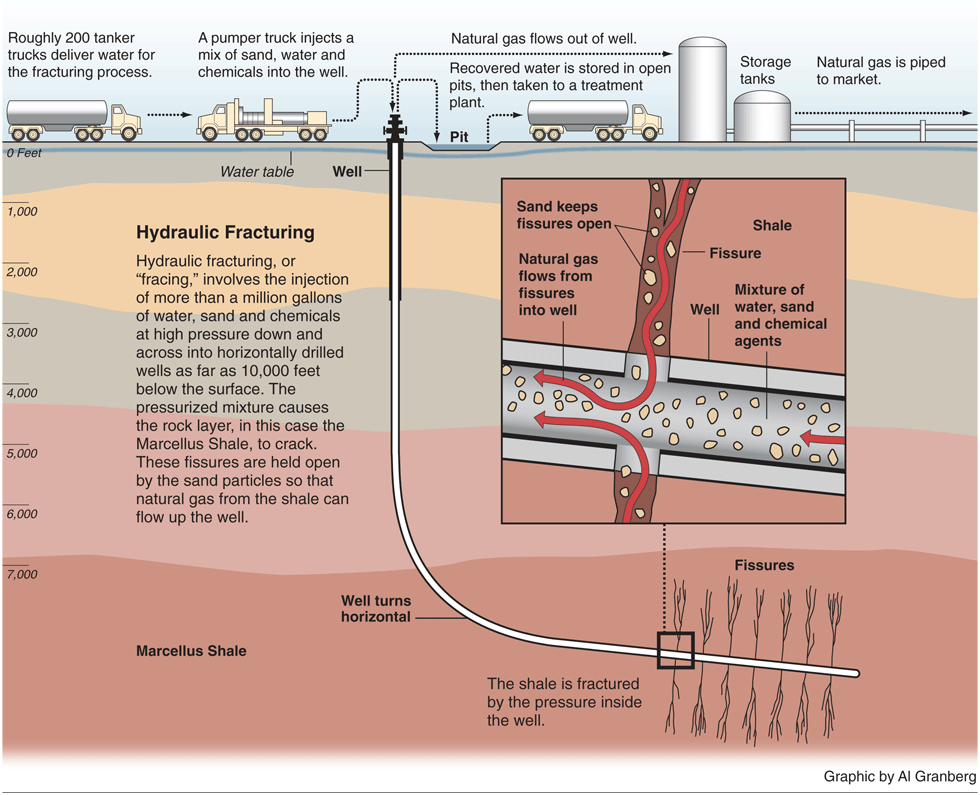
The hydraulic fracturing process injects water, sand, and other ingredients at very high pressure into the well. The high pressure creates small fractures in the rock that extend out as far as 1,000 feet away from the well. After the fractures are created, the pressure is reduced. Water from the well returns to the surface (known as flowback), but the sand grains remain in the rock fractures, effectively propping the fractures open and allowing the gas to move. Most frac fluid used in shale gas wells consists of water, a proppant (generally sand), a friction reducing agent (to help the flow-back water return from the well at the end of the frac job), and other chemicals used to protect the well and to optimize performance.
The US Department of Energy estimates that for a typical well in the Marcellus formation, 80,000 gallons of water are needed for well drilling, and 3.8 million gallons for fracturing. Water and sand comprise more than 98 percent of the fracing fluid. 30-70 percent of the fracing fluid returns to the surface as flowback. Thus, there is a large volume of contaminated water from each natural gas well that must be treated in some fashion.
In my next post, we’ll review recent innovations found in Way Better Patents Water Index that apply to the water used in hydraulic fracturing operations.