Showing posts with label agriculture. Show all posts

Tuesday, July 3, 2012

A Ray-Gun for Crop Pests


A Ray-Gun for Crop Pests

This is a serious invention, but I can’t get a vision of “The Far Side” out of my mind.
“Microwave system and method for controlling the sterilization and infestation of crop soils” was patented by William T. Joines of Durham, NC on October 13, 2009. Given Patent Number 7,601,936 by the USPTO, it is classified as 219/695 for electric heating using microwave heating with a waveguide applicator and an input power port arrangement.
Given the rather longish first claim, we’ll get the gist of this invention from its abstract:
“The method and the system are applicable in farming activities, pest control, industry, agriculture, forestry, etc. for controlling insects and other plant pests from crops. The system performing the method comprises a source of lethal impact which is a microwave generator with a microwave guiding element directed so as to infested soil. The microwave energy is transferred from a microwave generator into the pests located in the desired soil location, killing the plant insects and pests.”
A member of the patentECO Agriculture Index family of patents, this innovative use of microwave technology may help to improve crop yields by reducing (permanently) soil infestations of insects, grubs, and other pests.
For an approach to furry underground pests, check out the Rodenator web site and videos. I’ve spoken with someone who has observed one of those bad boys up close and personal, and he said it’s really something. The groundhogs were less of a problem after that.
Gary Larsen, you retired much too soon.

Tuesday, June 12, 2012

Sunflower Season Will Soon Be Upon Us


Sunflower Season Will Soon Be Upon Us

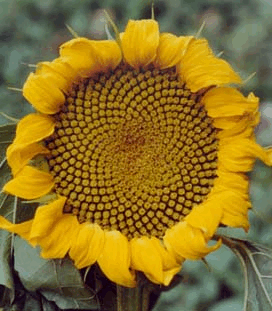
Sunflowers (Helianthus annuus) are a beautiful and fascinating plant. A sunflower is actually a flower head composed of 1000-2000 individual florets which mature into seeds. The beauty of the sunflower is directly tied to its geometric regularity and the opposing spirals of florets and seeds. Each floret is oriented 137.5 degrees to its adjacent floret; this pattern is based on a mathematical series known as Fibonacci numbers, and on the Golden Mean. Do some reading on these terms — their history and uses are fascinating. The pattern observed on sunflowers is the most efficient for packing seeds in a flower head.
Sunflower seeds are edible by humans, birds, livestock, and provide oil; the fiber in the plant stalks can be used in papermaking. The US Department of Agriculture estimates that in 2011, 1.5 million acres of sunflowers were harvested nationally (this area is 16% larger than the state of Delaware and twice the size of Rhode Island), yielding 2.04 billion pounds valued at $603.6 million.
The strength of sunflower production in the US may be due in part to Patent Number 4,254,580, issued on March 10, 1981. David B. Ferguson of Fresno, CA developed an invention for “Production of sunflower seeds in increased yields,” which was assigned to David & Sons, Inc., also of Fresno. The USPTO considers the invention to be one of multicellular living organisms and unmodified parts thereof and related processes, and more specifically, a method of using a plant or plant part in a breeding process which includes a step of sexual hybridization, and most specifically, a method of breeding involving a genotypic or phenotypic marker. You will find these inventions in classification 800/266.
Ferguson’s Claim 1 says:
“1. A process for the production of sunflower seeds in increased yields comprising: 
(a) planting in a growing area a plurality of seeds capable of forming Helianthus annuus sunflower plants which are physiologically self-compatible and possess homozygous f genes, said planting being carried out in the substantial absence of seeds capable of forming Helianthus annuus sunflower plants which are physiologically self-incompatible and/or lack homozygous f genes, whereby said seeds germinate to form sunflower plants, and seeds are formed on said sunflower plants as a result of self-pollination, said f genes having the ability to facilitate the formation of parenchyma cells between floret anthers which allow the anthers to become substantially non-fused following pollen dehiscence thereby making possible a greater degree of self-pollination with concomitant increased seed formation, and 
(b) harvesting said resulting seeds formed on said sunflower plants.”
Translating, the invention provides a novel and highly effective technique for enhancing the production of sunflower seeds via an agricultural process wherein a greater proportion of the florets which make up the sunflower are effectively pollinated.
Found in the patentECO Agriculture Index, along with other yield enhancement innovations, you can remember Ferguson’s contribution to you snack of sunflower seeds.

Tuesday, May 8, 2012

Innovation in Agriculture


Innovation in Agriculture

I referred recently to farmers as the first conservationists. This does not mean, however, that farming practices do not have negative environmental consequences. For that matter, depending on your perspective, all actions have negative environmental consequences. For example, the USEPA would have you believe that the carbon dioxide you exhale as a by-product of the cellular respiration that keeps you alive should be regulated as a pollutant.
Here in the Chesapeake Bay watershed (64,000 square miles), agriculture covers 23 percent of the land area (14,720 square miles). Government and academic scientists estimate that in 2009, agriculture was the largest source of nitrogen loading (45 percent or 110.6 million pounds per year) to the Bay. It was also the largest source of phosphorus loading (44 percent or 7.2 million pounds per year), as well as sediment (65 percent or 5.3 billion pounds per year). Many programs are in place at the federal, state, and local government levels to provide cost-sharing for agricultural practices to reduce nitrogen, phosphorus, and sediment runoff. The Chesapeake Bay watershed is now subject to a Total Maximum Daily Load, a water regulatory program of the USEPA.
Many bureaucrats and environmental advocacy groups would prefer that the public believe that the only way to correct environmental degradation is implementation of top-down governmental regulatory programs. This view intentionally ignores the power of innovation and free market economics.
Fortunately, there are inventors like Ronald D. Salestrom of Tucson, AZ. Salestrom has provided an “Agricultural water retention and flow enhancement mixture”; his intellectual property is protected by Patent Number 5,868,087, issued on February 9, 1999. The US Patent and Trademark Office classifies his invention as 111/132. This classification, found in a class covering planting inventions, pertains to broadcasting (think of your Scott’s rotary fertilizer spreader), specifically dispensing material ahead of a powered tiller.
Salestrom summarizes his invention in claim 1:
“1. A technique for treating agricultural land to increase water retention capabilities of the soil comprising a broadcaster and involving the steps of: 
a) distributing a substantially even spread of water absorbent polymer particles by said broadcaster over a soil surface; 
b) blending the water absorbent polymer particles into an upper level of said soil; and, 
  1. applying a linear polymer to said soil surface during irrigation of said soil surface.”
Inventor Salestrom envisions that his technique of applying selected chemicals will increase agricultural water retention and minimize erosion. The technique applies water absorbent polymers into the top layer of a field, creating a water barrier within the soil. Subsequently, a linear polymer such as polyacrylamide is applied to the soil's surface to minimize erosion during irrigation and precipitation. The water absorbent polymers assist in the thorough application of the linear polymer as the linear polymer is maintained at the surface area and prevented from leaching away. The combination of these techniques will serve to reduce nutrient and sediment losses from agricultural fields.
Has Salestrom’s invention (or others in the patentECO Agricultural Index) been added to the list of best management practices (BMPs) recommended by Chesapeake Bay governments?

Tuesday, May 1, 2012

How Many Environmentally/Ecologically Friendly Inventions - Agriculture Edition


How Many Environmentally/Ecologically Friendly Inventions?
Part 6 — Agriculture

Inventions in the Agriculture Index allow the US to continue to feed itself and a large fraction of the world.
I firmly believe that farmers were the first conservationists, and continue to be most directly tied to practices which conserve soil and water, as their livelihood depends upon it. Do you like to eat? Thank a farmer.
The four Agriculture Index patents in our survey cover four USPC classes:
  • plant husbandry
  • harvesters
  • plant protecting and regulating compositions
  • organic compounds
The United States leads the world in corn production. Oklahoma State University estimates that in 2009, 124,361 square miles of the US were devoted to corn production (this area is larger than every state with the exception of Alaska, Texas, California, and Montana). Thus, any improvement in planting, fertilizing, or harvesting practices or equipment has great potential to yield positive environmental benefits.
Enter Patent Number 7,373,767 issued and assigned to Marion Calmer (Alpha, IL) on May 20, 2008. Calmer’s patent, titled “Corn head row unit,” is placed by the USPTO in 56/95, which is a corn stalk type cutting harvester using spiral gatherers. The design of the harvester provides “a smooth uninterrupted improved flow of corn stalk material through the ear separation chamber and is the first row unit designed to be environmentally friendly by ensuring that the majority of the corn plant remains connected to its original root system which prevents it from rapidly decomposing, blowing or washing away.”
We hope this series has provided you a small glimpse into the types of recent patents that inventors have explicitly considered to be environmentally or ecologically friendly. They represent a tiny fraction of the innovations found within the patentECO Indexes.

Thursday, January 5, 2012

patentECO - The Way Better Patents View


The patentECO Clean Tech Ecosystem
In my introductory patentECO post, I referred to the clean technology ecosystem — what does this phrase mean?
Way Better Patents reviewed many definitions of “clean”, “green”, and “sustainable” technology. Some more accurately describe our view of clean technology than others, but we found that none capture key economic factors that are necessary for clean technology to provide viable products and services in a market-based economy.

Clean technology can be found across the innovative continuum.  Broadly clean tech is technology that uses less material and/or energy, minimizes waste, and lessen negative environmental consequences.  Clean tech can be found in the physical, chemical, electrical, biological, or computational disciplines.  
These technologies cover a wide spectrum of processes, products, services, and business models.  Clean tech delivers financial returns for investors, competitive prices for consumers, and profits for producers. The clean technology ecosystem is characterized by innovation that maintains a focus on efficient and productive use of natural and man-made resources in a sustainable manner — targeting human needs and desired products and services, while conserving resources and the environment so that these needs and desires may be met both now and in the future.
Clean technologies apply to agriculture, air pollution control and reduction, industry, energy, resource extraction or harvesting, transportation, and water and wastewater, and pertain to the resource inputs, processes, and supply chains that support them.
We have identified particular portions of the US Patent Classification system (USPC) and the International Patent Classification system (IPC) that cover clean technologies in these disciplines that pertain to:
  • Agriculture
  • Air,  air pollution control and reduction
  • Industry
  • Energy
  • Resource extraction or harvesting
  • Transportation
  • Water, water and wastewater
In upcoming posts we’ll review patented technologies in these areas from the standpoint of the defining aspect of the invention, and where it lies within the innovation space of that particular technology.
Additional details may be found on our patentECO web page. 

Tuesday, January 3, 2012

Welcome to patentECO


Today, Way Better Patent inaugurates our new patentECO blog.  patentECO will appear here on The Inkling.
patentECO is Way Better Patents’ ecosystem of clean technology innovation, as represented by patents issued by the US Patent & Trademark Office (USPTO), the European Patent Office (EPO), and other international patent organizations comprising the World Intellectual Property Organization (WIPO).
patentECO will review cleantech inventions and the patents that define them and the role patents play in the cleantech ecosystem.  We will review cleantech news items from an intellectual property (IP) and innovation perspective. We will focus on seven major categories within the clean technology ecosystem: air, industry; energy; water; resource extraction and harvesting, transportation and agriculture. We’ll take forays into other corners of the cleantech ecosystem as our interest leads us.
Michael Bowman, the Managing Editor of patentECO, is leading this effort.  Mike has decades of experience in clean technology, intellectual property analysis and management, innovation, and high tech knowledge management solutions. We will bring a unique perspective to the clean technology discussion.
Way Better Patents builds useful, easy to understand, engaging applications that transform complex data into compelling and expressive information. We are passionate about what we do, about providing real access to information in ways that help you gain insight and create knowledge. Way Better Patents applications are tools for exploration, tools for discovery, tools for analysis so you can explore, discover, analyze and execute — information you can use.