Showing posts with label snow removal. Show all posts

Tuesday, February 21, 2012

patentECO - Green Snow Removal


I Don’t Mind Snow, But I Can Do Without Ice

As I write this article in very early 2012, it is snowing here in Virginia’s Shenandoah Valley. A nice, gentle dusting of snow. Very unlike the Snowmageddon of 2009-2010. I’ve seen no indication of any snow removal equipment yet this morning, which reminds me, what about clean snow removal technology in the patentECO sphere?

For many years, various mixtures of grit and rock salt have been used on highways for snow removal and ice control. More recently, chemical compounds and mixtures that have a lower negative environmental impact and greater melting efficiency have been used.

Two recent patents illustrate this shift.

Patent number 7,879,254, “Snow removal agent and preparation method,” was issued on February 1, 2011 to Seung Cheol Jung and Moo Woong Jung, both of Incheon, South Korea. This patent is a continuation of patent number 7,666,324, “Snow removal agent and preparation method thereof,” issued the previous February 23 to the same inventors. Both patents are classified as 252/70, which are inventions for frost-preventing, ice-thawing, thermostatic, thermophoric, or cryogenic compositions.

The earliest US patent in this class and subclass was patent number 533,950, “Composition for melting snow,” issued in February, 1895. This early invention used a combination of water, common salt, acetic acid, and hydrochloric acid — perhaps not the best combination if one is interested in reducing environmental impacts.

Claim 1 of the ‘254 patent states:

“A snow removal agent for melting snow, comprising magnesium chloride, halite, urea, sodium tripolyphosphate and sodium metasilicate, wherein the sodium tripolyphosphate and the sodium metasilicate each account for an identical weight percentage in the agent, wherein the halite is crushed to a size of 7-20 mm and aged for 24-48 hours.”

Jung and Jung point out that their invention “reduces the corrosion of metallic materials of iron structures, automobiles, etc., is safe when used for a long period of time, is without the problem of re-freezing, significantly reduces the yellowing and withering of plants and is good for the growth of plants . . .” Further, their snow removal agent is “unharmful to plants, fish and shellfish.”

We find this invention in the patentECO Industrial index, which includes green chemistry and clean industrial technology. The slogan used by DuPont from 1935-1982, “Better Things for Better Living . . . Through Chemistry” certainly fits here.

Wednesday, January 11, 2012

patentECO - The Unintended Consequences of Inventions

The presence of the Patent Office and high tech, bio tech and innovation corridors and the Federal government organizations responsible for billions in research grants means that there is lots of innovation going on here.  In addition to inventing new stuff, a lot of people come here to see if the stuff they invent is any good. The Washington area is a special kind of melting pot. Lots of people from somewhere else brought here for work, military assignments, school, government or politics. We have representatives from every state representing their populace in Congress and people from every country with the possible exception of Cuba, Iran, and North Korea, as part of the diplomatic community. The people who come here bring their driving and shopping habits with them. The Washington area is a market research bonanza for everything from the McRib to the LED traffic lights. When it snows here it makes for an interesting opportunity to evaluate new signal light technology.

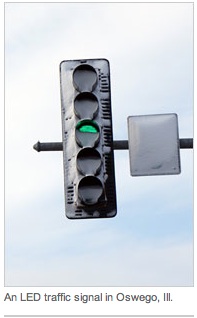
This time last year the New York Times reported on safety issues with LED traffic lights in its article called "LED Signals Seen as Potential Hazards". The LED traffic light offer many advantages to cash strapped municipalities - lower operating cost both in terms of power consumption and a tremendously long useful life compared with conventional signal lights. The LED traffic signals reduce the need for DOT personnel to hang precariously in bucket trucks above busy intersections to change the incandescent bulbs. One of the unintended consequences of innovation is that LED signals don't emit much in the way of heat. Lots of work went into making the lights work in the existing signal light housings. To do that you had to eliminate the heat.

The heat from conventional incandescent lamps is what melts the snow on traffic signals. Without the heat from the conventional traffic signal bulbs, snow and ice gets packed into the lights obstructing the lens so that you can't tell what color the light. This results in people having accidents. Tragically some of the accidents resulted in fatalities. To make matters worse, in storm situations only one side of the signal can be obscured - the side with the gusting wind. So one side works and the other doesn't. Not good in a snow storm when one side is working and the drivers on that side follow the lights and the drivers on the other side can't see what's going on with the lights.

The pace for replacing traditional incandescent signals with LED signals is accelerating. Wisconsin, a place with lots of snow, has converted more than 90 percent of the lighting controlled by the state to LED bulbs. So now instead of hanging precariously from bucket trucks to change bulbs, the DOT workers need to hang precariously from bucket trucks in the snow and use brooms to sweep off the snow and ice that obstruct the lenses on the traffic signals.

The LED traffic signal patents almost all tout the benefits of improved energy efficiency and lower cost to operate. Many of the inventions deal with techniques for improved heat dissipation so that the new LED lights can be retrofitted into existing traffic signal housings, and operate better in warmer climates. Others deal with improving the life of the LED lamps by reducing the heat emitted. One would assume from the New York Times article that the heat dissipating means which conduct heat away from the LEDs appear to be working particularly well since snow isn't melting from the lenses.

Enter US Patent 7,211,771 for a Deicing System for Traffic Signals. David Smith and Steven Canan of Precision Solar Controls, Inc. have invented a circuit for detecting and eliminating the buildup of snow and ice on the viewable face of an LED traffic signal lens. One circuit measures ambient temperature, a second transmits a signal when the ambient temperature is below a predetermined level, a third signal receives a reflection of the transmitted signal when frozen matter is present on the LED signal and the fourth signal heats the lens until the ambient temperature on the lens is above the predetermined level or the frozen matter on the lens is eliminated. The patent application was filed in November of 2005 and granted in 17 months on May 1, 2007, pretty quick.. The patent is clear and concise in disclosing the invention without all the vocabulary obfuscation of other patents. Precision Solar Controls has a hot patent in its portfolio and hopefully one that when put into action will eliminate the unintended consequence of LED traffic lights keeping the DOT workers out of the bucket trucks on snowy days. It will no doubt be of benefit in places where snow and ice and traffic lights are a hazardous mix during the winter helping perfect the LED signal light technology. Here in Washington we'll probably just stay home anyway.


*****
Here is a link to Phil Falconer's article at timesunion.com.  Another interesting discussion of the problem.


There's lots of information about the art and science of lighting at the Lighting Research Center which is part of Rensselaer Polytechnic Institute in Troy, NY.

The Federal Highway Administration of the US Department of Transportation has information on their latest research and development activities. Check out the Turner-Fairbank Highway Research Center and their research work.