Monday, August 13, 2012

Inventions in Black and White


At a recent meeting of the USPTO Business Methods Partnership one of the assembled masses, an attorney from one of those big patent prosecution factories, asked Terri Raines, eCommerce Division Manager, Office of Patent Information Management, who at the time was touting the new eFiling project, "When will we be able to file drawings that are in color?"

How odd was that question?  At Way Better Patents our business methods patent analysts refer to these most contentious of patents as, "Still Life with Flow Chart" due to the proliferation of flow charts used to explain how these computer implemented inventions with no moving parts are implemented.  What, do these patent guys need color to explain that the data moves through the memory in a method for "obtaining at the computer, forecasting with the computer, calculating with the computer, blah, blah, blah" to deliver  some revolutionary process and then transforms our lives by delivering electronic coupons to our desktop?

Imaging the fun the examiners will have when the flow chart patents came in with color drawings?  Imagine the problem with color blind examiners (about 7% of the male population.)  Think about the fun on the interviews, "no the red is the method, the blue is the computer or is it the green".  Maybe the patent attorney was really a life science guy or an electrical wiring guy.  Color drawings?  Really?  Yikes.

Inventions Should Be Black and White

Patent drawings are an essential element in the exchange between an inventor and a patent examiner. Drawings — a two-dimensional projections of breakthroughs in scientific, technical, and mechanical innovation — are the visual means through which the inventor conveys the novelty of technical and scientific advances of an invention.

You can look at the drawings of the patents that are 150 years old and understand what is going on.

USPTO's guidance is straightforward.  Patent drawings are an assembly of crisp perfectly black lines has been used to describe the greatest innovations over the history of US patent system. Lines made with drafting instruments or a laser printer — very dense, sharp uniformly thick and black — on smooth, nonshiny white paper. (Or hopefully on a monitor with decent resolution.)  No shadows, subtle hues, or solid black areas. Movement indicated by a simple dashed line. The jagged lines of contemporary printers and graphic design tools verboten.

Imagine patent drawings being distilled into invention cartoons, or worse, invention infographics.  With legends.

Imagine the impact on design patents.  "Apple's titanium isn't the same color as the Samsung titanium so the design patent is invalid."  

Imagine the time it will take at USPTO and beyond to come up with the standard for submission of color drawings.  (Yes, we understand that are certain scientific domains where color has meaning but those domains are in motion all the time and science and technology discoveries are expanding at an exponential pace.  Just ask a patent examiner.)  Imagine the public comment on that debate.  Sure to be colorful.  (Sorry, couldn't resist.)

Pushing for color drawing (images) at the same time that USPTO is busy spending millions on a modernization that appears to be anything but seems ill advised.  The folks at USPTO are talking about transitioning the application e-filing process from the perfectly fine PDF format to MS Word (another proprietary format doomed from the beginning.) at a time when most grownups (see the inventions in the business methods domain is you are wondering) are moving to formats like HTML5 and XML.    The idea of having discussions about changing the format of the drawings to color instead of figuring out ways to make the existing repository of TIFF drawings more accessible makes your head explode.  But I digress.

Patent drawings should be black and white whether they are made with pen and paper, Adobe Illustrator, or a CAD system or some pro se inventor (patent speak for an inventor who does all of the work themselves) who scans in a stick drawing of their invention.  As our friends at Wikipedia note, "A color is specified according to the intensity of its red, green and blue components, each represented by eight bits. Thus, there are 24 bits used to specify a web color, and 16,777,216 colors that may be so specified."  (I'd like to call to order the Red working Group of the RED GREEN BLUE (RGB) Patent Drawing consortium.")  Imagine the pixel by pixel analysis of color patent drawings!

Black and white is two colors (actually black is the only color, the background is white).  Two is enough.  All of the great patents have drawings in black and white.  It should stay that way.


Friday, August 10, 2012

How "Business Methods" Got Their Start

This week's addition to the Way Better Pagtents Inventions, Inventors, Innovation and IP Reading List is for the Still Life With Flow Chart™ Crowd — the creators of business methods patents.


The Information: A History, a Theory, a Flood by James Gleick — A roadmap to the evolution of the information age we live in and the information inventions that got us here.


This is an information and content dense book.  One of the most interesting aspects of this book is the discussions on how inventors and the public struggle with how to describe truly novel inventions, how hard it is to find the vocabulary to explain what the "telegraph" is to people who used the Pony Express to send their messages.  How inventors at Bell Labs were troubled by the lack of order in how to describe their science.  The discussions of the Babbage mechanical computer and Alan Turing's views on his own inventions create an inventive continuum of the information age.  From drum based message systems to the internet, Mr. Gleick explains where it all came from and where it's going.  It is a very nice catalog of prior art for those who think sending data across the wire for the purpose of conducting business is new.


(We added the link to buy the books at Amazon for two reasons - the pictures of the covers look good and if you buy one of the books from the link on, Amazon pays us a little change.  This helps us keep our product cost low. ) 


Thursday, August 9, 2012

Electricity From A Faucet — Nice Design, But Not A New Idea

Ryan Jungwoo Choi, a student in London, recently designed a fitting for a water pipe that converts the kinetic energy of flowing water in a water supply pipe to electricity used to power small, attached rechargeable light bulbs. A Google search on July 6, 2012 yields more than 6,200 hits for “Ryan Jongwoo Choi ES Pipe Waterwheel”. His web page describes the device:
“This product changes the power of flowing water into energy and makes it be used as light. This product devised to be used in the area of no electricity provided has been made to generate energy in life easily. The space where water flows is connected with pipes each other, when the above product is installed between each pipe, water is changed into energy by the principle of a waterwheel in the inside and accumulated in a bulb, and it can be used light in the place at desire after being detached.” [sic]
His illustration shows the use of small paddle-wheel turbines inside the fitting, presumably attached to small generators that charge the light bulbs.


Many of the web pages and blog articles I read about this device were written from a “this is completely new; it’s never been done before! How cool!” perspective. A search of patents and patent applications at the USPTO, WIPO (World International Patent Organization), and KPO (the Korean Patent Office — Choi is described as a “Korean innovator” on numerous web pages) fails to reveal any patent applications or patents to Mr. Choi. A phone call and follow-up email with staff at the International Design Society of America, from whom Choi’s design has received a 2012 IDEA award finalist ranking, indicated that his product is not presently distributed, and that there was no mention in the competition application filing of a patent application. Choi confirmed via email that he has not filed for a patent. Because his design has now been widely, and very publicly disclosed, it is unlikely that he could obtain a patent, at least in the US.

For all those who think this is new — not so fast.

Consider US patent US7956480, awarded Naoyuki Onodera and three co-inventors, all of Fukuoka, Japan, on June 7, 2011. The filing date of their patent application was November 1, 2008. Their patent, titled “Faucet generator” is considered by the USPTO to be a fluid-current motor falling within a broader group of prime-mover dynamo plant inventions. As such, it is closely related to other patents awarded under the  USPTO Green Technology Pilot Program. Claim 1 of the ’480 patent states:
"A generator for faucets, the generator comprising:
a case comprising a water inflow port and a water outflow port, wherein a water supply channel is formed inside the case;
a rotor vane disposed inside the water supply channel and configured to rotate by receiving a water flowing inside the water supply channel;
a magnet which is rotatable integrally with the rotor vane;
a bearing which supports a force that the rotor vane receives due to a water flow;
a rotation center shaft comprising one end supported by the bearing and the other end supported in a capped manner;
a coil which produces an electromotive force by a rotation of the magnet;
and a yoke comprising a base part arranged to surround the coil and a plurality of inductors which are spaced apart from each other and extending from the base part, wherein the coil is spaced apart from the magnet in an axial direction of a rotation center shaft and is disposed to face the magnet, the magnet is magnetized on an outer circumferential face thereof which intersects with a plane perpendicular to the rotation center shaft, and the inductors are disposed outside the case to face the outer circumferential face of the magnet."
Onodera et al.’s patent is illustrated in typical modern line drawing fashion.


Further, we link you to our February 23, 2012 post on “patentECO - Water on the Move”, which summarizes recent inventions on micro-hydro power generation (awarded to the Fairfax County Water Authority, the provider of municipal water to the International Design Society of America, headquartered in Herndon, VA).

But wait, there’s more.

US2436683, “Generator for Pipe Lines”, was issued on February 24, 1948 to Joseph H. Wood of Dallas, TX and assigned to Atlantic Pipe Line Company. Here is the first claim of that patent, issued 64 years ago (i.e., generating electricity from fluids flowing in a pipeline is not new):
"A device for generating electrical energy actuated by the flow of fluid through a pipeline, comprising
a housing adapted to form an integral stationary section of such line,
bearing means rigidly disposed axially of said housing,
a rotor positioned on said bearing means and adapted for operation while immersed in pipeline fluid,
permanent magnets affixed to the periphery of the rotor to create a magnetic field,
a stator surrounding the rotor and radially spaced therefrom,
an insulation cylinder interposed between the stator and the rotor and provided with an internal shoulder and an external shoulder at the opposite ends thereof,
and means for conducting electric current from the stator windings."
Note to designers, competition sponsors, and current or future inventors: check the prior art, particularly that described in published patents. And a corollary – don’t disclose your concept or design prior to filing a patent application if you hope to obtain patent protection for your intellectual property.

Tuesday, August 7, 2012

Where To Find Business Method Patents in 2013

The US Patent Classification System (USPC) is the only major patent classification system that is not based on the World International Patent Organization's International Patent Classification (IPC) system.  The USPTO and its colleagues in the European Patent Office (EPO) have been working on developing a new classification schema based on the EPO's European Classification System (ECLA).

The motivation to moving toward a new system was two fold.  First, the current USPC was becoming outdated and its structure didn't lend itself to the frequent updates needed for rapidly changing scientific and technical innovations.  Second, the USPC was the only major classification system that was NOT based on the International Patent Classification System.

The result was an bilateral agreement between USPTO and EPO to develop a join classification system to be used by both organizations.   The USPTO and the EPO are developing the Cooperative Patent Classification System (CPC),  a new classification system based on the EPO ECLA classification scheme, currently available via ESPACENET. ECLA, and soon to be the CPC, is drastically different from the current US Patent Classification system.

The 2012 Business Methods Partnership Meeting featured a presentation on the CPC.
According to John Weiss, a Supervisory Patent Examiner in Tech Center 3600 who presented “Introduction to the Cooperative Patent Classification (CPC) - EPO and USPTO Bi-Lateral Classification System”, Class 705 where most business methods are classified was determined to be a good candidate for early conversion to the new CPC scheme. During the past year US and European representatives negotiated the final CPC business methods scheme.

Business methods are found under the current ECLA G06Q scheme. Reviewing the scheme, it is evident that many of the Class 705 subclasses have been merged with the ECLA system. In contrast to the current US system of classes and subclasses, the ECLA, and soon CPC, system uses a group symbol of multiple components.

Here's how the new scheme looks.

Symbol Component Description
G Section (A, B, … H)
G06 Class (any 2 digits)
G06Q Subclass (any letter)
G06Q 30/00 Main Group
G06Q 30/016 Subgroup

Weiss showed the Main Groups that will soon be the classification “home” for business methods patents:
  • G06Q 10/00 — Administration Management 
    • Resource Management, Shipping, Human Resources, Hiring. These represent ‘behind the scenes’ aspects of business operations that customers normally don’t see.
  • G06Q 20/00 — Payment architectures, schemes or protocols
    • Electronic Funds Transfer, Billing Systems, Authorization
  • G06Q 30/00 — Commerce, e.g., shopping or e-commerce
    • Sales, Customer Service, Marketing. These represent the ‘up-front, customer-facing’ aspects of business operations. It is broader than equivalent subclasses currently in the USPC; advertising falls here.
  • G06Q 40/00 — Finance; Insurance; Processing of taxes
    • Banking, Accounting, Credit/Loan approval. This includes financial portfolio inventions.
  • G06Q 50/00 — Systems or methods specially adapted for a specific business sector, e.g., utilities or tourism
    • Social networking, Utility, Real Estate, Legal Services, Healthcare. Social networking and healthcare inventions are growing at a rapid rate at the USPTO, according to Weiss.
Mr. Weiss concluded his presentation noting that some areas of current USPC Class 705 best fit outside the ECLA/CPC G06Q symbol, and that some outside of Class 705 were pulled in to this European subclass revision.

There are several key points that have large implications for future classification and prior art searches of US inventions were not addressed:

The PGPubs and US Patent databases will be merged under the new system. There are significant quality issues associated with documents in the PGPub database related to claim structure, overall wording, and classification.  One of the issues here is that under the USPC there are circumstances where the scope of the invention morphs during patent prosecution.  This means that the new CPC will not account for those subtle changes in what constitutes the protected invention.

Under the CPC system, documents will be classified based on “invention information” guided by the claims. This change introduces a significant subjectivity into classification.  Although patents classified under the new system will have multiple classifications, documents will no longer have original (OR) or cross-reference (XR) classifications.

Many important aspects of the CPC have yet to be finalized:
  • It is unclear whether the new CPC data will be present on the front page of the printed patent.
  • The data products needed to update current commercial patent tools have not been developed.
  • The XML file format for the definitions and the symbol scheme has not been finalized.
  • It isn't clear how the Master Classification File and other supporting files will be made available to users.
  • There is no training on the new system planned for external practitioners and there was little discussion on the impact of the change on prior art researchers.  (A panel of speakers from PIUG presented an excellent list of concerns at the July CPC External User Meeting.
The system is intended to be implemented beginning January 1, 2013 with a two-year transition period in the US during which USPTO examiners will be using both systems. USPTO’s contractor for PGPubs classification is expected to begin using the new CPC system at the beginning of 2013.  In the short term, USPTO will continue to use the USPC for routing purposes.  (So now the patent examiners have yet another classification system to work with.)

The impact on the quality of prior art searching is also a serious concern.  Questions posed by audience members at both the CPC Users Meeting and the Business Methods Partnership Meeting regarding training for practitioners and users outside the USPTO did not receive particularly detailed responses. Apparently the plan is that there will be online training modules available, sometime, somewhere.  (In both cases the vibe was, "we'll get back to you on this one."

The USPTO directs questions to details and status of the Cooperative Patent Classification system to the official CPC website. For a program with such large implications for IP prosecution in the US, the USPTO web page is remarkably free of easily-located and prominent information on the upcoming changes. You have to burrow in to the Office of Classification page before you find a link to the CPC, and that page provides no information other than to include a link to the CPC. For all of the focus on External Users, this is curious.

But here is a more fundamental business methods question.   How is including US business methods patents in a cooperative program with the EPO, which doesn’t allow business methods patents, actually going to work?

Saturday, August 4, 2012

Water Powered Car - Really?

New Flash - An inventor in Pakistan has invented a water fueled car.  According to the Associated Press, "The engineer says the kit powers the car through the process of electrolysis, whereby a current from the battery passes through distilled water filled with electrolytes, separating out the hydrogen from the oxygen. The hydrogen, which is combustible, is fed into the engine to power it"

The scientific crowd reports that it violates the basic rules of physics.  Details, details.

You can read the article here.  And watch the YouTube video here.

Friday, August 3, 2012

Imagine - Your Brain, Your City, Your Crew

Insight and Thought Leadership or Liar, Liar, Pants on Fire

An entry from the Way Better Patents Reading List that has been pulled.

This post was written before it was revealed that Jonah Lehrer fabricated material in this book, notably quotes from Bob Dylan on how he created his music.  A July 30th story in the New York Times details how Mr. Lehrer fabricated the Dylan quotes and how he was exposed by Michael C. Moynihan in a Tablet article.  It calls into question the accuracy of the rest of the book.

We present our original review here.  Perhaps we were hoodwinked too.  The publisher has pulled the book off the shelves and is recalling it.  Time will tell if it resurfaces.  But in the meantime, here's what we originally wrote.  Amazon is in the process of pulling the book off its digital shelves as well.   If you get a question mark where the image goes, we will know the deed is done.

The original review.

This book may help you answer that important question, "Why didn't I think of that?"  This book is one of the best explorations of how people create things from the vantage point of how they think about them, what factors influence their thinking, and how who you hang out with can help drive your creativity.

Mr. Lehrer presents some interesting ways patents provide indicators that creativity is happening. And they are very revealing.  An analysis of patent citations reveals that "innovation was largely a local process, citations were ten times as likely to come from the same metropolitan area as a control patent."  Inventors are inspired by people in the 'hood.  And the best hoods for making this happen are the urban ones.  This is among the interesting information Mr. Lehrer presents.  (We aren't so sure about this one and are working to see if there is any truth on the citation front.)

Here the journalistic writing style makes even detailed information about neuroscience digestible and thought provoking.


Imagine by Jonah Lehrer — A great resource on understanding where ideas and creativity come from. Good insight on how patents point to good things happening. We were a bit put off by the hackneyed and unenlightened "fix the patent system" rhetoric without a plan at the conclusion of this book. (Note to self, write to Mr. Lehrer and see what his recommendations are.)


Thursday, August 2, 2012

Powered by Lightening....


Lightning as an Energy Source?
Yes.
A recent article at RealClearScience.com entitled “Could We Harness Lightning as an Energy Source?” provided estimates of the energy contained in lightning (An average bolt of lightning, striking from cloud to ground, contains roughly one billion (1,000,000,000) joules of energy), energy usage in US households, the annual number of lightning strikes in the US, and concluded that only about 0.6% of US households could be fully powered by lightning in the country. The author summarized engineering limitations of converting lightning to useful electricity, and concluded, “Sadly, it is completely, utterly unfeasible to use lightning for electricity.”
One of the fundamental bases for patentable inventions in the US is defined in Chapter 35 Section 101 of the US Code.
“Whoever invents or discovers any new and useful process, machine, manufacture, or composition of matter, or any new and useful improvement thereof, may obtain a patent therefor, subject to the conditions and requirements of this title.”
Inventions meet the “useful” criterion if they provide an identifiable benefit and are capable of use. An invention must work in order to receive a patent.
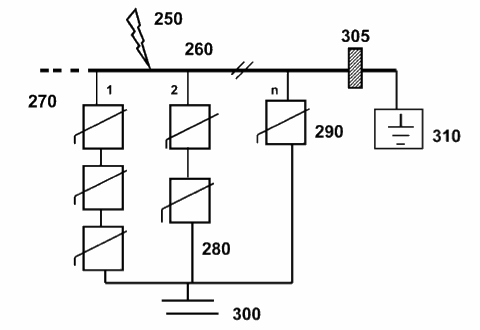
The blog article conclusion quoted above is incorrect in light of US Patent 8,045,314 issued on October 25, 2011. For the patent to have been issued, the examiner must have made a determination that it meets the requirements of 35 USC 101, including that the invention will work (i.e, it is not “completely, utterly unfeasible”).
The patent provides a “Method of atmospheric discharge energy conversion, storage and distribution”, was awarded to Effiong Etukudo Ibok of Sunnyvale, CA and assigned to The Travis Business Business Group, Inc. The USPTO considers the invention to be an electrical system or device that uses charge generating or conducting to modify an environmental electric charge. We place this patent in the patentECO Energy Index.
The patent’s first claim states:
“A method of converting an atmospheric electrical discharge into a useable form of electrical energy comprising deflecting the discharge to an air terminal via one or more separate air terminals of a polarity, the air terminal having an opposite polarity to the polarity of the separate air terminals;
arresting the discharge via the air terminal to a power mitigating (step down) unit via a conducting unit connected to the air terminal;
wherein said power mitigating unit is not a transformer, reducing voltage of the discharge via the power mitigating unit modulated according to a capacity of the power mitigating unit, wherein the discharge is grounded if in excess of the capacity, and wherein the power mitigating unit reduces the voltage of the discharge from approximately higher than 100 MV (mega volt) and 100 kA (kilo amperes) to below 20 kV (kilo volt), 10 kA;
and storing the discharge with the reduced voltage in an energy storage unit connected to the power mitigating unit, the storage unit comprising modules of high energy density capacitors and the storage unit discharging the electrical energy into a power grid or to an appliance.”
The background of the invention provides this nugget:
“Lightning strikes every part of the globe but not uniformly. The regions with the highest historical concentration of lightning strikes . . . include Florida and the Gulf Coast in the Americas, the Equatorial Highlands of DRC, Rwanda and Burundi in Central Africa and the Monsoon Belt in Asia. 
Except for the Americas, typically, these regions have very little electricity infrastructure. With the capability disclosed here, substantial reserves of electricity can be generated, stored and possibly traded.”

Thus, the inventor’s purpose is to provide a renewable energy source to developing nations that lack the electrical infrastructure and reserves of the US (and whose households would use a small fraction of the electricity consumption of US households).
This invention, issued by the USPTO Green Technology Pilot Program, is not the first of its kind. It cites 10 other patents as prior art, the first of which (US Patent 911,260) was issued to Walter Pinnock of Philadelphia in 1909 (157 years after Ben Franklin’s famous kite experiment in the same city). Pinnock, like recent inventor Ibok, provided a lightning collection mechanism and a storage unit (a battery in his case, ultracapacitors in Ibok’s). Both inventors sought to harness a renewable energy source. The illustrations are from Ibok’s and Pinnock’s patents.


The ability to successfully commercialize a patent is a far different venture than inventing a process or mechanism that is useful — that works.